Author: Mona Cavallero (Page 11 of 16)

Greenstone Hollow Nature Preserve – Trip Report – 5/14/2022

Greenstone Hollow Nature Preserve

Trip Report, May 14, 2022

The day was cloudy but dry.  Four of us gathered for the Greenstone trip, including two new people to the preserve.  Despite being in migration season, very few of the birds were singing.  We had to ferret out looks to find most species.

We had a House Wren at the street even before taking to the trails.  We also had a Yellow Warbler and Wood Thrush there.

Continuing on we had both Black and White Warbler and Common Yellowthroat singing in the shrub swamp.  Then we scared an American Robin from its nest, next to the trail.

In the cedar woods we heard Ring Necked Pheasant a couple of times. Although introduced by the neighboring game club, they are rarely detected.  Then we got a photo of a Black Billed Cuckoo in a tree.

Back by the marsh we had a Blue Winged Warbler calling and got good looks at a pair of Rose Breasted Grosbeaks and a Baltimore Oriole.

We had a total of 28 species, including 4 warblers.

Larry Lunden


Species:

Mallard  1,  Ring-necked Pheasant  1,  Mourning Dove  4,  Black-billed Cuckoo  1,  Red-bellied Woodpecker  4,  Downy Woodpecker  2,  Eastern Phoebe  3,  Blue Jay  3,  Black-capped Chickadee  4,  Tufted Titmouse  2,  Tree Swallow  1,  House Wren  1,  Carolina Wren  2,  Gray Catbird  1,  Wood Thrush  1,  American Robin  3,  House Sparrow  1,  American Goldfinch  5,  Song Sparrow  1,  Baltimore Oriole  1,  Red-winged Blackbird  11,  Brown-headed Cowbird  2,  Blue-winged Warbler  2,  Black-and-white Warbler  3,  Common Yellowthroat  1,  Yellow Warbler  3,  Northern Cardinal  5,  Rose-breasted Grosbeak  2


Keney Park 5/8/22 Walk – Trip Report Submitted by Annette Pasek

The day’s chill was brief though the dim lighting lasted but the first hour of our three-hour walk. The Mother’s Day walk at Keney Park, the jewel of Hartford began at 8:30. We had 26 attendees ranging from beginning birders to a few intermediates. Coverage of 3+ miles, with lots to explore of the 693-acre park. We had 60 species though likely more. One unidentified warbler, parulidae specie may have been a rarity, calling churee, yellow bellied and green back, seen by few, face seen by none.

Highlights were American Kestrel, 12 warbler species, including both waterthrushes, vireos and flycatchers and even one sole hummingbird spotted by the youngest member of the group, an elementary aged girl. A surprise Savannah sparrow allowed many closeup views as it was alit on a nearby treelike shrub, though twas not as great a surprise as the Mama bear and her two cubs in a wooded trail area.

Annette Pasek, President

Quarry Park/Connecticut River Floodplain Trip Report – Apr 30, 2022 Submitted by Larry Lunden

Quarry Park and Connecticut River Floodplain – Trip Report, Apr 30, 2022

Submitted by Larry Lunden

A sunny but windy day greeted us as we started out the walk.  Two of us turned out to see what was in the park.  Three if you also count Merlin.

The upper level of the quarry had the usual birds. We saw a white spot in a tree on the crest of the hill.  Looking closer it was a hawk, and flying we saw the tail of a Sharp Shinned Hawk.   Some White-throated Sparrows were still around.  On the lower level one House Wren was singing, but did not come out in view.  Merlin added a Blue Headed Vireo and a Rose Breasted Grosbeak but we did not see them.  Overhead we saw a Great Blue Heron.  No warblers were found.

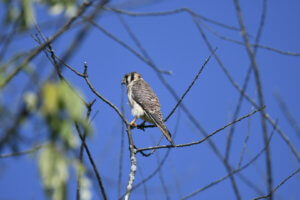
We followed the quarry with a trip through the meadows.  In a large puddle in a field we saw a group of 14 small birds feeding in the mud.  We puzzled over them with no luck.  Merlin directed us to American Pipit, which we could confirm by sight.  In another puddle we found three Least Sandpipers, giving us two special birds of the day.  To top it off we saw an American Kestrel sitting on its nesting box, and then it flew off.

Overall we had 32 species, but no warblers.

Larry Lunden

Species at Quarry Park:

Mourning Dove  7,  Great Blue Heron  1,  Sharp-shinned Hawk  1,  Red-bellied Woodpecker  7,  Downy Woodpecker  3,  Eastern Phoebe  3,  Blue-headed Vireo  1,  Blue Jay  8,  American Crow  1,  Black-capped Chickadee  2,  Tufted Titmouse  3,  House Wren  1,  European Starling  1,  American Robin  17,  House Sparrow  1,  Chipping Sparrow  1,  White-throated Sparrow  4,  Red-winged Blackbird  6,  Brown-headed Cowbird  2,  Northern Cardinal  9,  Rose-breasted Grosbeak  1

Species in Rocky Hill Meadows

Mallard  11,  Mourning Dove  1,  Killdeer  5,  Least Sandpiper  3,  Great Blue Heron  2,  Turkey Vulture  2,  Red-bellied Woodpecker  5,  American Kestrel  1,  Blue Jay  1,  American Crow  1,  Tree Swallow  8,  Barn Swallow  1,  European Starling  5,  American Robin  4,  American Pipit  14,  American Goldfinch  9,  Savannah Sparrow  1,  Song Sparrow  5,  Red-winged Blackbird  4,  Northern Cardinal  3

Greenstone Hollow Trip Report – 4/16/22 – Submitted by Christopher Fisher

Trip Guide – Christopher Fisher

Greenstone Hollow Trip Report for walk on 4/16/22 – 8am.

Weather – Sunny, Temperature 55ºF – 59ºF

Attendees:

Chris Fisher, Diane Fisher, Matthew Poltorak, Sue Gagliardi, Edee Vassar, Davis Smith, Laura Ray, Peter Bulkley, Abby Wolcott, Joan Craig, Niki Bonnett, Carol Michaels, Beverly Greenspan, Doug Murray, Karen Walsh, Larry Lunden

Description – We walked 1.7 miles covering most of the trails in the refuge.  Below is a picture of the track of the paths we covered.

Birds Seen (reported to e-bird) – 36 species

Canada Goose  5
Mallard  5
American Black Duck  2
Ring-necked Pheasant  1
Mourning Dove  8
Great Blue Heron  2
Turkey Vulture  1
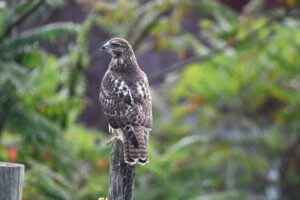
Red-tailed Hawk  1
Downy Woodpecker  3
Northern Flicker  1
Eastern Phoebe  2
Blue Jay  3
American Crow  5
Common Raven  1
Black-capped Chickadee  1
Tufted Titmouse  1
Tree Swallow  7
Ruby-crowned Kinglet  1
White-breasted Nuthatch  1
Carolina Wren  3
European Starling  1
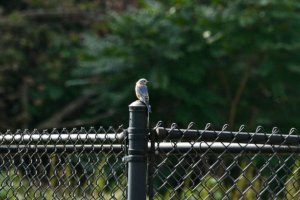
Eastern Bluebird  1
American Robin  8
House Sparrow  6
House Finch  1
American Goldfinch  2
Chipping Sparrow  3
White-throated Sparrow  2
Song Sparrow  4
Eastern Towhee  1
Red-winged Blackbird  8
Brown-headed Cowbird  4
Common Grackle  3
Palm Warbler  2
Yellow-rumped Warbler  1
Northern Cardinal  8

Additional Notes:

  •  The Bluebird was carrying nesting material indicating possible nesting activity
  • We identified a flowering Spice Bush.
  • We identified a Callery Pear Tree also known as a Bradford Pear which was growing along the trail.

Study group-April 9, 2022 Hartford Riverfront Boathouse, Riverside Park -submitted by Annette Pasek

Trip Leader/Coordinator – Annette Pasek

April 9th, 2022, Meeting Location – The Hartford Riverfront Boathouse, Riverside Park

20 Leibert Rd, Hartford

Group of six, Cynthia, Jon, Maggie, Annette, Debra and Susan

Start time 11 am, Chilly 50 degrees and rain – 11:45 at the finish of our study and before our walk. After a brief wait in our cars the walk preceded, the group walked south on the west promenade walkway until water across the path stopped the group. The walk continued north of the boathouse with stationary views only due to water over the path northward. 21 species were noted.

Canada Goose
Mallard
Hooded Merganser

Mourning Dove
Killdeer

Double-crested Cormorant
Red-tailed Hawk
Downy Woodpecker

Northern Flicker
Eastern Phoebe
Northern Rough-winged Swallow
Carolina Wren
European Starling
American Robin

House Sparrow
House Finch
Song Sparrow
Red-winged Blackbird
Common Grackle
warbler sp. (parulidae sp.)
Northern Cardinal

Discussion of inland shorebirds and migratory, Killdeer, Spotted Sandpiper, Solitary Sandpiper, Greater and Lesser Yellowlegs and Upland Sandpiper. Literature and dvd’s were shared. Extra binoculars were used by beginner birders.

This was the first of seasonal study group, a reprise to the original Hartford Audubon Study Group Club which began in 1908.

Sachuest Point NWR – 3/26/2022 Rhode Island Trip Report by Paul Desjardins

On Saturday March 26, 2022  fourteen people gathered for my annual trip to the Rhode Island shoreline. The starting point was at Sachuest Point N W R. There to greet us was a cock Ring Necked Pheasant who casually walked across the parking lot affording great close up looks! I was informed by a veteran Rhode Island birder that pheasants are countable only on Block Island but it was still nice to see. As we began our walk we soon encountered various waterfowl including all three scoter species and numerous Harlequin Ducks, both loons, several Horned Grebes, Great Cormorants and many Purple Sandpipers. For reasons unknown we usually miss the species so it was a real treat to see so many!

Next we went to Trustom Pond N W R where we always pick up on passerines. However, with the bird feeders having been taken down over concerns about avian flu there was little action here. We then proceeded to the area where the waterfowl congregate only to see the water almost devoid of them!  We did see several Common Mergansers that are uncommon here but as we walked further down the trail to the observation platform we encountered hundreds of ducks. So that is where they were out of sight. The raft included hundreds of Greater Scaups, Ring Necked Duck, Ruddy Ducks and best of all a drake Canvasback.

Upon returning to the parking lot everyone wanted to call it quits except myself and another birder who has a home near a birding spot called Deep Hole in Matunuck. Here we picked up several Hooded Mergansers, another Ring Necked Duck and best of all a Glaucous Gull and Iceland Gull side by side! We ended with 53 species.

Paul Desjardins, guide

Silver Sand Trip Report – 3/20/2022 Submitted by leader Maggie Peretto

Silver Sands Trip Report

Five people joined me at Silver Sands this morning.

Pleasant weather and 35 species of birds made it a very Pleasant walk.

We were surprised with a couple of Monk parakeets at the start of the walk.

Everyone enjoyed watching and listening the Clapper rail in the marsh and very close to the boardwalk.

Thank you to the participants.

Good birding and enjoy spring.

Maggie Peretto. Manchester, CT


2/26/2022 Birding with Your Phone Workshop – Report

2/26/2022 Birding with Your Phone Workshop – Report

Ever go birding and see someone bent over their phone, doing something about birds but you can’t tell what it is?  You’re not alone – many birders are using many apps to improve our skills and log our observations.  This was the impetus for creating our Birding With Your Phone workshop, presented in February for our third year in a row, and the second time to be held virtually over Zoom.

Ken Elkins of Audubon Connecticut once again expertly led our attendees through a variety of apps designed for smart phones.  He showed screenshots and provided navigating advice for a number of apps including the Audubon Field Guide, Merlin, iNaturalist, BirdNet, and the Warbler Guide, among others.  He ended the program by giving tips about using eBird.   Shown below is a link to a you tube recording of the session.

https://youtu.be/0gubQ9jh2Zc

If you could share any feedback from the evaluations you sent after the workshop, that would be appreciated. All in all, it was another helpful, informative workshop – thank you, Ken!

Sarah Faulkner

2021 HARTFORD CHRISTMAS BIRD COUNT SUMMARY

2021 HARTFORD CHRISTMAS BIRD COUNT SUMMARY

(The 2021 Hartford Christmas Bird Count is dedicated to the memory of long time Area Captain and former HAS President, Gil Kleiner. Gil, we missed you covering Windsor on this year’s Count!)

Last year’s Hartford Christmas Bird Count featured a foot of snow on the ground.  This year, there was none!  What’s more, warm temperatures throughout the fall kept even small ponds open. So, on a day without snow and ice, and temperature reaching well into the thirties, why were there so many complaints throughout the State about how few birds were seen on the first weekend of the Christmas Count season?  Let us consider some plausible explanations.  First, the lack of freezing temperatures may have kept waterfowl, raptors and other birds from moving southward out of northern New England.  Would these same conditions, however, allow some species to linger in our area rather than move to warmer climes for winter?  Second, the mild, open conditions also allowed birds to find food over a wide area and kept them from clustering in sheltered areas near restricted food supplies.  Third, a big issue on Count Day was a cold 10-15 mph northwest wind that made it feel much colder than it actually was.  When birding, wind is not your friend, as many birds remain hidden away.  Wind gusts atop the Hartford Landfill probably exceeded 20 mph on Count Day!


So, was the Count a bust?  Hardly!  In spite of the fact there were 85 field observers, 27 fewer than participated in 2020, and we covered almost 75 fewer party miles than two years ago (2019), overall numbers were not terrible.  Our 87 species was three below our ten year average of 90.1 species.  If only we could have found the three Count Period species (birds seen three days prior to or three days following the Count, but not on Count Day), we would have hit 90!  Alas, the Cackling Goose at Wethersfield’s Mill Woods Park, American Coots in South Windsor and at Batterson Pond, and the American Pipits in the Rocky Hill Meadows could not be located on Count Day.  We did, however, total 45,870 individual birds on the Count, over 14,000 more than in 2020.  Of course, two species, Canada Goose and American Crow, made up more than half the total.   In fact, Canada Goose reached a ten year high count, perhaps not surprising without snow covering the fields, lawns and golf courses.

Other ten year high counts were reached by Turkey Vulture, Bald Eagle (tie), Common Raven, Gray Catbird, Eurasian Starling, Vesper Sparrow, Yellow-rumped Warbler and Red-winged Blackbird.  Eagles and ravens have been increasing in our area, while several others no doubt benefited from the mild conditions of late fall.  Highlights for the Count included four Pink-footed Geese in South Windsor. This marks the first time this species has been included in our Count Circle.  Other rarities included a Pied-billed Grebe and a Northern Shrike, also seen in South Windsor. The grebe last appeared on our Count in 2012, while this marks the fourth time in the past ten years that a single shrike has made the Count, the last in 2018.  A female Greater Scaup in Hartford’s “sewage lagoon” pond near Riverside Park marked this species’ second appearance since 2012, while the American Wigeons in East Hartford marked this handsome duck’s first appearance since 2016.  Other birds of note included an Iceland Gull in Wethersfield (more on gulls, later), single Snow and White-fronted Geese from the Rocky Hill Meadows, a pair of Northern Pintails, an American Kestrel and a Marsh Wren in Glastonbury, and single Hermit Thrushes in Glastonbury and Hartford.  Finally, there is no doubt that the Glastonbury Meadows is the place to be if you are a sparrow.  The Meadows produced 10 sparrow species including fox sparrow seen for the first time since 2017, a record high five Vesper Sparrow, and a Lincoln’s Sparrow for the second time in three years!  An eleventh species, Field Sparrow, was nearby in Glastonbury.  In addition, of 149 American Tree Sparrows seen on the Count, 128 came from the meadows, although this number is far below record years when the farm fields were left unplowed.  The Meadows also produced the Count’s only White-crowned and Swamp Sparrows, and also, the only Rusty Blackbirds and one of Glastonbury’s two Ruby-Crowned Kinglets.

There were several significant misses in 2021.   Following last winter’s irruption of Red-breasted Nuthatch, this species went undetected for the second time in three years.  Barred Owl and Merlin were both missed for the first time since 2000.  In the case of the owl, wind did not make early morning owling easy.  In fact, only a single Great Horned Owl was tallied.  The Merlin miss was surprising as this species seemed to be relatively common earlier in the fall.  The big shocker, however, was the absence of Great Black-backed Gull, which has been declining since the closure of the land fills about ten years ago.  The last time this gull failed to appear on our Count was in 1963, 58 years ago!  Only Ring-billed Gulls with their penchant for sitting on parking lots, seem to be holding steady with the highest total since 2016.  A number of songbirds came in at ten year lows, and one must wonder how great a role the wind played when it came to Black-capped Chickadee, Tufted Titmouse, Northern Mockingbird, Cedar Waxwing (only a single bird reported from Glastonbury), and Northern Cardinal.  Hopefully, this is a one year blip, and does not continue into the future?  Finally, as anticipated, not a single winter finch was recorded on our Count this year.  It will be interesting to learn how other Connecticut Counts fared when it came to siskins, redpolls, etc.

I would like to thank the area captains, without whose participation this Count would not be successful.  Thank you, also, to all those field observers, owlers, and feeder watchers for giving up some time during the Holiday Season to go out and tally birds.  The Christmas Bird Count, begun in 1900, is the longest running of all “citizen-science” field studies.  Over time, the Count offers valuable information about trends in bird populations during the early winter.    I hope to hear from you all again next year (and on the Summer Bird Count, the second weekend in June). Happy New Year!

Jay Kaplan, Compiler

Hartford Christmas Bird Count

Lewis farm Sanctuary 10/19/21- Trip Report submitted by leader Abby Wolcott

Lewis farm Sanctuary 10/19/21 – Written by Trip Leader Abby Wolcott

Quick facts:  53 degrees and sunny

4 people on the trip

10 species of birds seen or heard

Length of trip: 2 miles, 2  plus hours

An intimate group of birders gathered at the trail head on this crisp October morning.  As we headed off, a flock of geese provided some overhead entertainment as they demonstrated their telltale  chevron flight pattern above us.  We had our binoculars at the ready as the conversation unfolded regarding  what we had been seeing in our travels and some of the  local trips that were especially memorable.

After crossing the brook we started to hear more birds and scanned the treetops for activity.  We ambled along and saw a flock of yellow rumped warblers and made note that our snow bird, the dark eyed junco was back.  We were happy to see him and reminded ourselves to keep our shovels and ski parkas at the ready in the next few weeks.

We watched a red bellied woodpecker as he worked on a dead limb.  He was cooperative enough to do this as the sun shone on his back revealing what a beautiful bird he is. This viewing  prompted a discussion on the changes of birds seen here in New England over the past few decades. It was encouraging to note the increase in many  species in these parts.

Jays and crows provided some background noise as we looped around the trail.  We stopped to listen to two pileated woodpeckers calling out  but it was too much to ask of them to reveal themselves on this fine morning.  We told ourselves we would meet the king of woodpeckers on  another day and our quest continued.

On our return route we spied a bird of mystery in the tree tops and he remains thus.   He darted  about  and did not cooperate for the camera or binoculars but provided a source of speculation for some birders who had been around the block.

Heading around the white pine grove we day dreamed about owls.  They were not to be seen today but we stopped to see chickadees flitting and were reminded of E.B. White’s accurate observation that chickadees   “demonstrate the power of positive thinking.” That they did, but we really didn’t need much help as we were immersed in the beauty of nature and making connections with new friends who share a love of birds.

« Older posts Newer posts »

© 2026

Theme by Anders NorenUp ↑