Author: Mona Cavallero (Page 3 of 17)
Hilltop Farm Trip Report
September 3, 2025
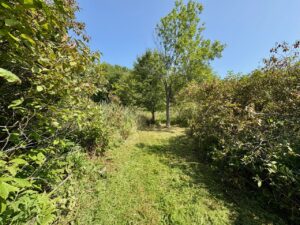
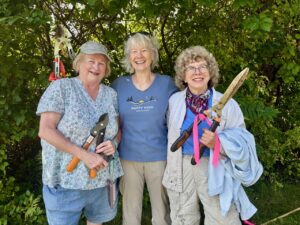
Once upon a time, there was an elementary school librarian who retired and found she missed the chattering of little children and the camaraderie of the teaching staff. She reached out to a local nonprofit to connect with people, nature, and to stay physically active. The location is just 1.5 miles from home and an easy commute. Thus began my volunteer tenure at Hilltop Farm in Suffield, CT. I help create and maintain several of our bird-friendly and pollinator gardens (HAS helped with grants) and oversee the Community Garden. I lead this bird walk every year to connect with others in the birding world and to share this property, which has been a vital part of Suffield’s history and now a significant part of my retirement.
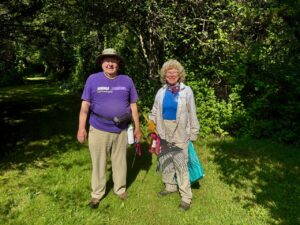
Today I led a group of 12, including my husband Tom. All were Hartford Audubon members. Some had visited the property before, others had not. (The Creamery may have had something to do with that.) We were fortunate to have beautiful weather with blue skies, puffy clouds, and a temperature in the low seventies, accompanied by no humidity. I started our walk by admitting I needed everyone’s help to identify birds, as my visual acuity is a bit impaired by cataracts that will soon be removed. I also mentioned that bird calls are not my specialty, even before being diagnosed with hearing loss. But what an understanding group they were! The Hartford Audubon insists you do not have to be the best birder to lead a walk. Share your enthusiasm and knowledge, and the camaraderie of the group will fill in the blanks. This group did just that! We identified 27 species and maybe two yellow warblers in the goldenrod.
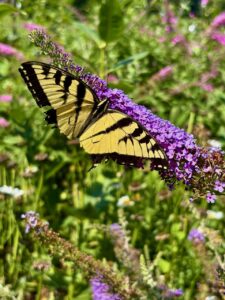
We began our walk heading east from the red barn. Gray Catbirds started us off, and goldfinches, hairy and red-bellied woodpeckers, and eastern wood-pewees soon appeared along with cedar waxwings. To the north, on a dead tree, sat a Cooper’s Hawk and some northern flickers. At the bottom of the hill, we followed the wooded trail and slowly approached the inland pond, where one great blue heron and two green herons were across the water. Blue jays, crows, mourning doves, and Carolina wrens provided background chatter when things got quiet. We backtracked through the woods. Some ventured down to the riverbank and saw an osprey flying across the river. We returned to the open field where tobacco was harvested just last week, and the fields are brown and barren now. We walked parallel to the river, spotting robins and a cardinal along the way. We ventured up the hill with a ruby-throated hummingbird and turned right toward the boardwalk, where warbling vireos were high atop the canopy singing. Above the pussy willow arch on the boardwalk, more waxwings were spotted. The fields, now covered with goldenrod and joe pye weed, were summer breeding grounds for bobolinks, meadowlarks, and red-winged blackbirds. We only saw one blackbird today and two tree swallows in this area. We headed west and walked the road by the community garden, seeing goldfinches and song sparrows. One of our gardeners said it was a banner day for hummingbirds this morning, but I think they took an early lunch, as we did not see any while there. Up the hill again, a northern mockingbird was spotted on a post. We visited the Bird and Pollinator Garden (also HAS funded). A grackle, a starling, and a turkey vulture can be included in our observations.
You are familiar the saying, “The early bird catches the worm.” I may have to change it to, “The late bird catches the worm.” After everyone had left and we were packing the car, I spotted a flock of eastern bluebirds in the black cherry tree behind us. Sure enough, one of them was on the ground catching a worm!
Joan Heffernan

HARTFORD SUMMER BIRD COUNT SUMMARY – JUNE 7-8, 2025
The Hartford Summer Bird Count (SBC) was held on June 7th-8th. This marked the fourteenth consecutive weekend that featured some rain. More importantly for our Count, the month of May 2025 was the third rainiest May since the start of record keeping, and temperatures struggled to reach 70 degrees Fahrenheit. In fact, the thermometer reached 70 on only four days the entire month. Such cold, wet weather is known to play havoc with the nesting season, and how many waterfowl nests that were washed out by high water levels cannot be determined. It is known that several participants remarked upon a lack of ducklings, although Canada geese goslings seemed to have weathered (sorry about that) the cool, damp conditions.
Saturday began overcast with temperatures in the mid 60s, and by 10 am the predicted rains had arrived, and they continued throughout the day. Sunday also began overcast and cooler, and while there was no measurable precipitation, the skies did not begin to clear until later in the day with the mercury reaching into the mid-70s later in the afternoon.
Although skies were gray, and there are always numerous conflicts to mid-June birding, 61 participants fanned out over our 15 mile diameter circle, only two fewer than the previous year. Of greater interest, 47 parties birded for a cumulative 177.5 hours, 5 more parties and 15 more hours than in 2024. Total species tallied was 109, three fewer than last year, and a reasonable total considering the weather. Eight species seen in 2024 were absent this year. These Gadwall, Northern Harrier, Sharp-shinned Hawk, Solitary Sandpiper, Great Horned Owl, Red-breasted Nuthatch, Winter Wren, and Black-throated Green Warbler. Several of these are not to be expected on our Hartford Count, while others like the owl were likely victims of inclement weather for night birding. Five species that did not appear last year found their way onto this year’s Count. These included a pair of Green-winged Teal at Station 43, South Windsor, three Herring Gulls making their way down the Connecticut River in Glastonbury, a Yellow-billed Cuckoo and a Least Flycatcher, both in Glastonbury, and a surprising total of 9 Brown Thrashers from three areas, including birds with young in Manchester and Bloomfield! Other rarities included a Least Sandpiper in Manchester, and an American Woodcock in Bloomfield. Several warblers of note included Worm-eating in Bloomfield, Black-and-white in Farmington/Avon and Chestnut-sided in both Farmington/Avon and Manchester. Manchester also tallied a pair of White-throated Sparrows, a species that apparently no longer nests in Connecticut.
In terms of numbers, American Robin again led the way with 1143 individuals. This total, some 250 fewer than in 2024, would likely have been higher if not for the rains of Saturday! Rounding out the top five were European Starling (1065), House Sparrow (834), Red-winged Blackbird (797) and Gray Catbird (460). The catbird beat out Common Grackle (459) by one bird! Although several areas commented on a paucity of ducklings, waterfowl numbers were higher for Canada Goose, Wood Duck and Mallard this year. Other water birds including Double-crested Cormorant and Green Heron also showed increased numbers. All raptors with the exception of Cooper’s Hawk and Bald Eagle showed a decrease, in part, no doubt because overcast, rainy weather is not conducive to soaring. Higher numbers were tallied for all woodpeckers (except Northern Flicker), the three recorded vireo species, all the flycatchers, Blue Jay and Common Raven. Swallows were down in number with the exception of the Purple Martin colony in Glastonbury that showed a small increase from 8 to 10 birds. Cliff Swallow colonies continue at West Hartford Reservoir #6 and at CIGNA in Bloomfield. A steep decline for Bank Swallows could be attributed to fewer sandbanks and sand piles in which this species builds its nests. Chickadees and titmice increased in number, while White-breasted Nuthatch, Carolina and Northern (note the new name) House Wren decreased. Orioles, particularly Orchard Oriole, increased over 2024, while Red-winged Blackbird and Common Grackle both declined. Finally, House Sparrow showed a significant increase of 18%. This was due to one area making a concerted effort to count the house sparrows in their town.
This is the Hartford Summer Bird Count’s 35th year, and whereas we might not garner the species totals found on those counts that take place along Connecticut’s coast, there are plenty of birds to be found in our part of Connecticut.
The Summer Bird Count is an important survey, providing information on the status of breeding bird populations. Thank you to the area captains and all participants who donated their time to participate in the Count this year. Results of ours and the other seven Connecticut SBCs will be published in an upcoming edition of The Connecticut Warbler, the quarterly journal of the Connecticut Ornithological Association. A full accounting of the species found on the Hartford Count is available by e-mailing me at jaybrd49@aol.com
I hope that many of you will be able to participate in our 2025 Christmas Bird Count, the longest running of all “citizen science” surveys. The Christmas Count will take place on Sunday, December 14, 2025. Save the date!
Jay Kaplan, Compiler
Hartford Summer Bird Count
19 optimistic Hartford Audubon members met at Reservoir #3 in Bloomfield about 8am. I say optimistic because the weather forecast was threatening rain, but then early Saturday, the forecast moved the rain back to about 10am – so we hoped it would hold off. Reservoir #3 has about a ¾ mile long road out through a field which has had nesting Bobolinks the past several years. We were not disappointed. Everyone got really good looks at Bobolinks, both male and female, perched and flying. We also saw 33 other species of birds including a couple of nesting Great Blue Herons and surprisingly, and Orchard Oriole was heard. Some of us also had a good look near the end of the walk at a Willow Flycatcher which we’d been hearing. As promised, the first drops of rain started to fall at 10am! Here’s a list of the birds we saw.6 Mallard3 Mourning Dove1 Green Heron3 Blue Heron3 Red-tailed Hawk1 Red-bellied Woodpecker1 Eastern Wood-Pewee2 Willow Flycatcher1 Great Crested Flycatcher1 Eastern Kingbird3 Warbling Vireo1 Red-eyed Vireo1 Blue Jay8 Tree Swallow1 White-breasted Nuthatch8 European Starling6 Gray Catbird3 Eastern Bluebird3 Veery2 Wood Thrush6 American Robin5 Cedar Waxwing6 American Goldfinch6 Song Sparrow1 Field Sparrow1 Eastern Towhee1 Baltimore Oriole12 Red-winged Blackbird1 Brown-headed Cowbird2 Common Yellowthroat4 Yellow Warbler1 Northern Cardinal1 Indigo Bunting10 Bobolink1 Orchard Oriole35 Species total
On Sunday, June 1st, five bird watchers gathered at Station 43 in South Windsor for a three-hour walk featuring wetland bird species. The temperatures were unusually cool for this time of year (48 degrees), which certainly helped hold off the onslaught of mosquitos that were predicted to show up after two days of prior rain.
We began our trip near the parking area where a Red-tailed Hawk was discovered sitting in a well exposed nest. Above us, were the sights and sounds of over twenty Cedar Waxwing actively consuming the nectar from flowers on an old Tulip Tree.
After a brief greeting and introduction, the group headed off slowly down Newberry Road, birding and botanizing along the way. The loud vocalizations of Carolina Wrens, Common Yellowthroats and Yellow Warblers drowned out most of the surrounding birdsong, but we did luck out by hearing not one, but two Least Flycatchers along the trail. While observing the flycatchers, our attention was diverted to a Red-bellied Woodpecker, who was delivering a bill-full of insects to a nest hole!
The search for wetland bird species began with our arrival to the Station 43 Sanctuary itself. Here we spotted a few Wood Duck and a fly over Great Blue Heron. Marsh Wrens and Swamp Sparrows were heard singing in the distant reeds. Also heard were the distinctive calls of both Willow and Alder Flycatchers. The ubiquitous Red-winged Blackbird was seen throughout, with a striking all-black body and orange-red and yellow shoulder patch.
In the past, our search for the elusive Least Bittern could sometimes take a bit of patience and perseverance. But today our group was fortunate enough to quickly locate a bittern in flight, traveling from one side of the marsh to the other. It flew a second time a few moments later to the delight of all!
With our target bird secured, birdwatchers collectively decided to head over to nearby Vibert Road for some additional birding. Here we discovered that some of the farmland had recently flooded, which led to the appearance of a few late migrant shorebird species. We tallied five Greater and one Lesser Yellowlegs, as well as eight Semipalmated Sandpiper voraciously feeding on invertebrates as they refueled for their journey north. The standing water also produced a bumper crop of mosquitos, which also attracted numerous hungry Bank Swallows and Chimney Swifts.
Our trip tallied a total of 47 bird species.
Respectfully submitted, Paul Cianfaglione, trip leader
Eight people joined us for this spring walk around Fisher Meadows park in Avon Connecticut on May 17.
It was a cloudy foggy morning and the weather leading up to the day had generally not been great so our expectations for true migrants was low.
Therefore, we focused on the songs of many resident birds. We were not disappointed in finding many of the residence species, including Baltimore Orioles, Rose breasted Grosbeaks, Great Crested Flycatcher, Warbling Vireo, Orchard Orioles, and a good supply of Yellow Warblers. A double crested cormorant was seen fishing in the pond. We were lucky enough to find at least two Wilsons Warblers through their song and got decent looks at both of them. We also found a Magnolia Warbler via its song and then got some tantalizing views through the pine tree. There was at least one Canada Warbler heard briefly, but not everybody got on the bird or got looks.
We had a total of 40 species for the day.
Thanks to Barry Marsh keeping a list of what we saw and heard.
Brian Toal, Trip Leader
Penwood State Park, Bloomfield. May 10th, 2025
On Saturday, May 10th nine bird watchers gathered at Penwood State Park in Bloomfield for a three-hour walk, in search of warblers, thrushes and vireos. Prior to the trip, Hartford County was experiencing a string of cool, rainy days. The weather conditions for our walk saw no rain, but it was still cloudy, dreary and a tad bit cool with temperatures around 50 degrees.
As birders greeted each other at the start of the walk, a number of species were noted around the entrance pond including Warbling and Yellow-throated Vireos, Baltimore Oriole, Pine Warbler and Blue-gray Gnatcatcher. Our only Eastern Wood-Pewee was also heard in the same general area. The Wood-Pewee was a first-of-the-year species for many of us.
The newly paved entrance road into the park made walking more enjoyable, but it was also a good place to spot hungry thrushes looking for an easy meal. It wasn’t long before we discovered several Wood Thrush and Veery feeding in clear view. Unfortunately, the rainy conditions during the past couple days may have delayed the arrival of the much-anticipated Swainson’s Thrush into the forest.
Our journey into the heart of Penwood’s beautiful woodlands was quite spectacular, but it also presented us with the daunting task of finding tiny warblers high among its sprawling canopy. Birders patience, and sore necks were finally rewarded with views of Northern Parula, Black-throated Blue and Black-throated Green Warblers, Black-and-white Warbler and American Redstart. A singing Tennessee Warbler was also an exciting find.
Even more exciting were the sights and sounds of a territorial Worm-eating Warbler, a target bird for the trip. Nearby, a Least Flycatcher sang its emphatic, dry “CHEbek”!
Other familiar birds that were recorded during our walk down to the park’s picnic area included Great Crested Flycatcher, Red-eyed Vireo, Scarlet Tanager and Rose-breasted Grosbeak.
The park-like setting, and its fringes at the far end of the path offered different species not found in any other parts of Penwood. Here we added Tree Swallow, Eastern Towhee, White-throated Sparrow, Indigo Bunting and Northern Flicker. A few lucky birders in our group had brief looks at a singing Cape May Warbler feeding high within a large oak tree. A Barred Owl calling in the near distance was a nice way to end our visit to this beautiful Connecticut State Park!
Our trip produced a total of 62 bird species.
Respectfully submitted, Paul Cianfaglione, trip leader
Auerfarm State Park – Trip Report