Author: Mona Cavallero (Page 6 of 17)

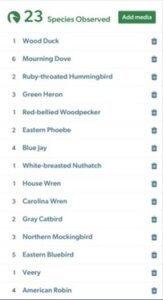
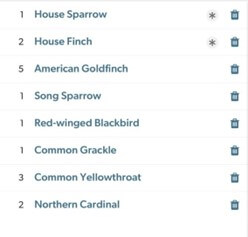
Station 43 Wetland Bird Walk, South Windsor 6/1/2024

On Saturday, June 1st thirteen bird watchers gathered at Station 43 in South Windsor for a three-hour walk featuring wetland bird species. The weather turned out to be picture-perfect with clear skies, sun and very light winds. The mosquitos along Newberry Road were also sympathetic to the cause allowing most people a pain-free visit.

After a brief greeting and introduction, the group headed off slowly down Newberry Road, birding and botanizing along the way. Slow, and very quiet would be the best way to describe how this bird walk began. But the activity soon picked up with the sights and sounds of multiple Yellow Warblers. Joining the Yellows was a vocal tree-top Magnolia Warbler as well as an American Redstart. Seven Cedar Waxwings perched high in a dead tree garnered birder’s attention as did the activity of nesting Gray Catbirds.

The search for wetland bird species began with our arrival to the Station 43 Sanctuary itself. Here we spotted Green Herons, Swamp Sparrows, a pair of Belted Kingfishers and a number of Wood Duck. Marsh Wrens were heard singing in the distant reeds. The ubiquitous Red-winged Blackbird was seen throughout, with a striking all-black body and orange-red and yellow shoulder patch.

The most surprising sighting of the day was that of a fly-over Great Egret!

Our search for the elusive Least Bittern took a surprisingly long time, but patience and perseverance finally had its reward with sightings of two birds chasing each other over the marsh. Kudos to the group for keeping a positive attitude during the bittern vigil!

After the exciting Least Bittern sighting, birdwatchers collectively decided to head over to nearby Vibert Road for some additional birding. Here we added Orchard Oriole, Wild Turkey and Killdeer. A brief walk into the woodlands along the Connecticut River produced Warbling and Red-eyed Vireos, Wood Thrush and Hairy Woodpecker. Heard calling across the river were Great Crested Flycatcher and Pileated Woodpecker.

We ended our trip at the Vibert Road boat launch. From the river bank, birders enjoyed close up comparisons of both Bank and Northern Rough-winged Swallows. A pair of Common Merganser startled us as they floundered away from the shore, and then floated gently downriver. The late addition of Bald Eagle and Osprey was the finishing touch to a glorious day of birding.

Our trip tallied a total of 61 bird species.

Respectively submitted,

Paul Cianfaglione, trip leader

Hartford Audubon Society Keney Park – Bird Walk 5/4/2024

41+ unidentified buteo species greeted us during our Keney Park annual spring walk, co-hosted by Al Gatti and Annette Pasek. 22 grouped up for a 2.4 mile walk.
Light to no winds, starting out gray and lightening up as the morning went on. The Baltimore orioles were frequently seen and heard throughout the walk.
Keeping our eyes and ears out for warbler species produced eight in all.
Birders had good looks at yellow-rumps, black and white, while hearing two Scarlet tanagers calling in the area.

Keney Park hosts a variety of habitats. eBird list shared with all but two of those attending.

41 Species Observed
Observations
  1. Number observed: 2
  2. Number observed: 8
  3. Number observed: 1
  4. Buteo sp.

    Number observed: 1

    Details

    Likely red-tailed
  5. Number observed: 7
  6. Number observed: 2
  7. Number observed: 4
  8. Number observed: 1

    Details

    Pee-a-wee
  9. Number observed: 1
  10. Number observed: 4
  11. Number observed: 1
  12. Number observed: 3
  13. Number observed: 6
  14. Number observed: 2
  15. Number observed: 2
  16. Number observed: 6
  17. Number observed: 6
  18. Number observed: 7
  19. Number observed: 1
  20. Number observed: 4
  21. Number observed: 14
  22. Number observed: 8
  23. Number observed: 1
  24. Number observed: 4
  25. Number observed: 34
  26. Number observed: 3
  27. Number observed: 5
  28. Number observed: 9
  29. Number observed: 11
  30. Number observed: 12
  31. Number observed: 6
  32. Number observed: 14
  33. Number observed: 3
  34. Number observed: 6
  35. Number observed: 1
  36. Number observed: 4
  37. Number observed: 1
  38. Number observed: 1
  39. Number observed: 11
  40. Number observed: 2
  41. Number observed: 1
Annette Pasek, trip leader

Lewis Farm Trip Report – 5/1/2024

By Abby Wolcott

On this overcast morning 8 local birders took a break from their work or household chores and headed to Lewis Farm to look for birds.

The birds would not be silenced and sang as we headed down the trail.  Fortunately, two members of the group had clearly spent hours listening to tapes of bird calls and were able to help us ID what we heard from the treetops.

By the time we crossed the Billy Goat Gruff bridge, the birds became more of a reality and one lone yellow warbler sat on a branch long enough for all of us to get a good look.  We heard northern parulas, black –throated blue warblers, black and white warblers and a tanager in the distance.

But we continued on hoping to come face to face with more of the birds that serenaded us.  A black and white warbler scrambled up and down a tree truck for all to admire.  Several oven birds and wood thrushes called from the forest floor but were reticent.

We all admired the burst of green as spring has come to life and the wildflowers adorned the trail as we headed on. Of course, we had a chance to learn more about our fellow birders swapping stories of sightings we had shared, places we had visited, as well as life lessons we had learned as we meandered back over the bridge.

An elusive silhouette of a warbler appeared and flitted in the canopy, all eyes on him.  After much deliberation, and research in the field on various apps, we were able to confirm the black- throated green warbler thanks to his tell-tale yellow markings on his head.

We headed up the hill and the oven bird called again asking us to come back and stroll this lovely property soon as one never knows what other birds would be unveiled.


Penwood State Park Bird Trip Report – 5/11/2024

Penwood State Park, Bloomfield. May 11th, 2024

On Saturday, May 11th ten bird watchers gathered at Penwood State Park in Bloomfield for a three-hour walk, in search of warblers, thrushes and vireos. With temperatures in the upper 30’s, the expectations for this trip appeared to be lower than in past years, but the clear skies and sun soon brought bird activity back to its normal frantic pace.

A welcome sight before our bird walk was the discovery of a migrant Common Loon and Great Blue Heron just overhead. Birders also took note of the sounds of American Redstarts, Warbling Vireos and Baltimore Orioles adjacent to the pond near the park’s entrance.

It was not long before we discovered our first of three Swainson’s Thrush feeding directly on our path, which made it easy for birders to study and enjoy. Less easy were the views of wood warbler’s high overhead as they fed on caterpillars in the trees sunlit canopy. Northern Parula, Black-throated Blue, Black-throated Green and Tennessee Warblers were eventually identified, despite our sore necks.

A little further down the trail, a Louisiana Waterthrush and a pair of Worm-eating Warbler fought for bird watcher’s attention, with the Worm-eating Warblers stealing the show with stunning, close-up views of their striking plumage.

The tall-mature woodlands at Penwood State Park were certainly a delight to see, but it also made locating birds a real challenge. Birding by ear challenged us in a different way, allowing us to slow down and appreciate the songs of Tennessee, Blackburnian and Hooded Warbler a little bit more. Birders also took audio notes of Red-eyed Vireo, Magnolia Warbler and Wood Thrush.

The open and expansive picnic area at the northern end of the walking path added to the park’s habitat and bird diversity. Here we found Chipping Sparrows, Eastern Bluebird, Tree Swallows and Northern Mockingbird. An area of shrubland also revealed the presence of nesting Indigo Buntings and skulking House Wrens.

The return trip back to our cars saw the group enjoy eye-level observations of both Yellow-throated Vireos and Scarlet Tanagers.

Our trip produced a total of 62 bird species.

Respectively submitted,

Paul Cianfaglione, trip leader

South Glastonbury Great Pond Bird Walk – 5/24/2024

The morning list started before 8 a.m. 9 were in attendance. The weather was mild and cloudy most of the morning though the rain kept at bay and the sun came out for the last hour of this 3 hour walk. We had very little to look at on the pond, Hooded mergansers. Though most of the rest of the walk delivered a decent return, 33 species in all. The Field sparrows treated us to frequent song as we grouped up and continued throughout this 2.45 mile walk. Surprisingly no heron, and only one warbler species being, Palm warblers.
33
Species Observed
119 individuals

Observations

  1. Hooded Merganser

    Number observed: 2

  2. Mourning Dove

    Number observed: 1

  3. Red-shouldered Hawk

    Number observed: 1

  4. Belted Kingfisher

    Number observed: 1

  5. Yellow-bellied Sapsucker

    Number observed: 2

  6. Red-bellied Woodpecker

    Number observed: 2

  7. Downy Woodpecker

    Number observed: 3

  8. Pileated Woodpecker

    Number observed: 1

  9. Northern Flicker

    Number observed: 1

  10. Blue Jay

    Number observed: 4

  11. American Crow

    Number observed: 8

  12. Black-capped Chickadee

    Number observed: 9

  13. Tufted Titmouse

    Number observed: 2

  14. Tree Swallow

    Number observed: 4

  15. Northern Rough-winged Swallow

    Number observed: 5

  16. Ruby-crowned Kinglet

    Number observed: 6

  17. White-breasted Nuthatch

    Number observed: 2

  18. Blue-gray Gnatcatcher

    Number observed: 2

  19. Carolina Wren

    Number observed: 4

  20. American Robin

    Number observed: 5

  21. House Finch

    Number observed: 3

  22. American Goldfinch

    Number observed: 4

  23. Chipping Sparrow

    Number observed: 2

  24. Field Sparrow

    Number observed: 3

    Details

    Frequent singing in field triangle position
  25. White-throated Sparrow

    Number observed: 13

  26. Song Sparrow

    Number observed: 2

  27. Eastern Towhee

    Number observed: 3

  28. Red-winged Blackbird

    Number observed: 2

  29. Brown-headed Cowbird

    Number observed: 10

  30. Common Grackle

    Number observed: 6

  31. Palm Warbler

    Number observed: 3

  32. Northern Cardinal

    Number observed: 2

  33. Rose-breasted Grosbeak

Annette Pasek, trip guide

East Rock Park Bird Trip Report – 5/11/2024

On Saturday May 11, from 7 am to 12 pm, ten birders gathered at East Rock Park in Hamden for my annual trip there. This is one of the premium spots in the state for observing migration particularly if there has been a heavy movement the night before. Unfortunately such was not the case this time.
We started out on the lower level where we first heard and then saw a Northern Waterthrush which being a migrant raised expectations of many more migrants. Warbling Vireos sounded off but are only local breeders as were the Baltimore Orioles.
We did come across a red phase Eastern Screech Owl which was a joy to see. But the droves of migrants just were not there in numbers. Only single Northern Parulas, American Redstarts or Black and White Warblers for example. No Wilson’s Warbler at “Wilson’s Corner”. We did come across an Eastern Wood Pewee which was a new year bird as we headed for the upper level.
The upper level can be very productive if conditions are right but just as the lower level was quiet so was the upper level. We did pick up both Black Throated Blue and Black Throated Green Warblers and our Scarlet Tanager count climbed to four. So basically, it was the kind of day where we had to really work to pick up new species for the day. On a really good day there can be so many birds that one has to be quick so as not to miss anything.
Despite the conditions we managed to see or hear 55 species.
Paul Desjardins, guide

Lower Greenwoods Rec. Area Barkhamsted – Trip Report 5/7/2024

Results of yesterday’s walk in Barkhamsted. Thanks to Gina for co-leading and to Doug, Paul, Nick, and Dave for joining us.
Catherine Delasco

Lower Greenwoods Rec. Area – Barkhamsted
May 7, 2024
10:20 AM
Traveling
0.75 miles
125 Minutes
All birds reported? Yes
Comments: Submitted from eBird for iOS, version 2.20.4 Build 2.20.28

1 Mourning Dove
1 Ruby-throated Hummingbird
1 Green Heron
3 Turkey Vulture
2 Red-bellied Woodpecker
1 Least Flycatcher — Heard singing nearby
1 Eastern Kingbird
1 Yellow-throated Vireo — Heard singing nearby
1 Warbling Vireo
1 Blue Jay
1 Black-capped Chickadee
1 Tufted Titmouse
1 Blue-gray Gnatcatcher
1 Carolina Wren
3 Gray Catbird
1 Wood Thrush — Heard singing nearby
4 American Robin
2 American Goldfinch
1 White-throated Sparrow
1 Song Sparrow
4 Baltimore Oriole
3 Red-winged Blackbird
3 Blue-winged Warbler
4 Common Yellowthroat
5 American Redstart
4 Yellow Warbler
3 Chestnut-sided Warbler
3 Yellow-rumped Warbler
1 Scarlet Tanager
2 Northern Cardinal
3 Rose-breasted Grosbeak

Number of Taxa: 31

Dismal Brook Bird Walk Trip Report – 5/9/2024

Five participants enjoyed a fine morning at Dismal Brook, finding 57 species, including 12 warblers.  Highlights were a first-of-the-year Swainson’s Thrush, an adult Broad-winged Hawk, an Ovenbird carrying a caterpillar, an obviously mated pair of Rose-breasted Grosbeaks and a show-stopping appearance by a Black-throated Blue Warbler.  My complete eBird checklist (minus the Turkey Vulture that I missed) is below.
John Weeks
Dismal Brook Wildlife Preserve, Hartford, Connecticut, US
May 9, 2024 7:01 AM – 10:48 AM
Protocol: Traveling
2.0 mile(s)
Checklist Comments:     Bird walk for the Hartford Audubon Society.
56 species
Canada Goose (Branta canadensis)  2
Wood Duck (Aix sponsa)  1
Chimney Swift (Chaetura pelagica)  1
Ruby-throated Hummingbird (Archilochus colubris)  1     Male.
Solitary Sandpiper (Tringa solitaria)  1
Green Heron (Butorides virescens)  1     First of the year.
Broad-winged Hawk (Buteo platypterus)  1     Adult.
Barred Owl (Strix varia)  1     Seen by the trip leader prior to the beginning of the bird walk.
Belted Kingfisher (Megaceryle alcyon)  1     Female.
Yellow-bellied Sapsucker (Sphyrapicus varius)  3
Red-bellied Woodpecker (Melanerpes carolinus)  2
Downy Woodpecker (Dryobates pubescens)  1
Pileated Woodpecker (Dryocopus pileatus)  1
Eastern Phoebe (Sayornis phoebe)  2
Great Crested Flycatcher (Myiarchus crinitus)  2
Yellow-throated Vireo (Vireo flavifrons)  1
Warbling Vireo (Vireo gilvus)  4
Red-eyed Vireo (Vireo olivaceus)  4
Blue Jay (Cyanocitta cristata)  2
American Crow (Corvus brachyrhynchos)  1
Common Raven (Corvus corax)  1
Black-capped Chickadee (Poecile atricapillus)  1
Tufted Titmouse (Baeolophus bicolor)  3
Tree Swallow (Tachycineta bicolor)  2
White-breasted Nuthatch (Sitta carolinensis)  1
House Wren (Troglodytes aedon)  1
Gray Catbird (Dumetella carolinensis)  4
Eastern Bluebird (Sialia sialis)  1
Veery (Catharus fuscescens)  2
Swainson’s Thrush (Catharus ustulatus)  1     First of the year.
Wood Thrush (Hylocichla mustelina)  2
American Robin (Turdus migratorius)  2
American Goldfinch (Spinus tristis)  1
Chipping Sparrow (Spizella passerina)  2
Song Sparrow (Melospiza melodia)  2
Swamp Sparrow (Melospiza georgiana)  4
Eastern Towhee (Pipilo erythrophthalmus)  2
Baltimore Oriole (Icterus galbula)  3
Red-winged Blackbird (Agelaius phoeniceus)  7
Brown-headed Cowbird (Molothrus ater)  1
Common Grackle (Quiscalus quiscula)  4
Ovenbird (Seiurus aurocapilla)  2     One carrying food (fat caterpillar?).
Blue-winged Warbler (Vermivora cyanoptera)  1
Black-and-white Warbler (Mniotilta varia)  2
Common Yellowthroat (Geothlypis trichas)  7
American Redstart (Setophaga ruticilla)  1
Northern Parula (Setophaga americana)  1
Yellow Warbler (Setophaga petechia)  4
Chestnut-sided Warbler (Setophaga pensylvanica)  3
Black-throated Blue Warbler (Setophaga caerulescens)  1
Pine Warbler (Setophaga pinus)  2
Yellow-rumped Warbler (Setophaga coronata)  2
Black-throated Green Warbler (Setophaga virens)  1
Scarlet Tanager (Piranga olivacea)  2
Northern Cardinal (Cardinalis cardinalis)  1
Rose-breasted Grosbeak (Pheucticus ludovicianus)  2     Pair together.
View this checklist online at https://ebird.org/checklist/S173076100

Lewis Farm Trip Report – 5/1/2024

By Abby Wolcott

On this overcast morning 8 local birders took a break from their work or household chores and headed to Lewis Farm to look for birds.

The birds would not be silenced and sang as we headed down the trail.  Fortunately, two members of the group had clearly spent hours listening to tapes of bird calls and were able to help us ID what we heard from the treetops.

By the time we crossed the Billy Goat Gruff bridge, the birds became more of a reality and one lone yellow warbler sat on a branch long enough for all of us to get a good look.  We heard northern parulas, black –throated blue warblers, black and white warblers and a tanager in the distance.

But we continued on hoping to come face to face with more of the birds that serenaded us.  A black and white warbler  scrambled up and down a tree truck for all to admire.  Several oven birds and wood thrushes called from  the forest floor but were reticent.

We all admired the burst of green as spring has come to life and the wildflowers adorned the trail as we headed on. Of course, we had a chance to learn more about our fellow birders swapping stories of sightings we had shared, places we had visited, as well as life lessons we had learned as we meandered back over the bridge.

An elusive silhouette of a warbler appeared and flitted in the canopy, all eyes on him.  After much deliberation, and research in the field on various apps, we were able to confirm the black- throated green warbler thanks to his tell-tale yellow markings on his head.

We headed up the hill and the oven bird called again asking us to come back and stroll this lovely property soon as one never knows what other birds would be unveiled.


2024 Roaring Brook Nature Center Field Trip Report – 4/28/2024

On Sunday, April 28th nine hardy birders joined trip leader, Jay Kaplan, in the Roaring Brook Nature Center parking lot at 6:30 am for a two plus hour jaunt along the trails of Werner’s Woods, a State of Connecticut property for which the Nature Center serves as steward.

The weather forecast was all over the map, with some models predicting cloudy conditions, while others called for intermittent showers.  Happily, the showers never materialized and, after checking the wooded areas adjacent to the Nature Center, where we heard birds like yellow-bellied sapsucker, house wren, and Louisiana waterthrush, we headed off into the woods.

Although the leaves are not yet out in late April, neither are the trees’ flowers, and thus, there is not as much to eat in the trees as there will be in a few weeks, when the flowers of oaks and other trees open up and begin to attract insects.  Nevertheless, our group stopped on several occasions to observe flocks of yellow-rumped warblers, and to listen to the first black-and-white and black-throated green warblers of the season.

Perhaps the highlight of the trip for many of us was the sound that baby barred owls make when they are begging for food from the parent. And, sure enough, a sharp-eye observer located an adult owl about 70 yards out in the trees.  After admiring the owl for a minute, we quietly moved away from the area so that the owl family could go about its business.

We continued to find yellow-rumped warblers, and who knows, there may have been other species with them. Alas, the visibility was poor and birds in the treetops showed little in the way of field marks.  A Cooper’s hawk, flapping and gliding above the trees, was the only diurnal raptor to make an appearance on this gray morning.

Approaching the pond, we observed a pair of wood ducks in flight, and a mallard soon alighted on the pond.  On a walk the previous day, there had been a more unusual American black duck in that same location.   Perhaps the rarest bird of the walk was a European starling seen in front of the Nature Center building upon our return to the parking lot.  We rarely see starlings here, something for which we are quite thankful.  It was now getting close to 9:00 am and time to think about breakfast and the rest of the day.

Our species count was 36, not bad for April.  A week from now, there will be many more species arriving as spring migration builds to its peak in mid-May!

Respectfully submitted,

Jay Kaplan, Trip Leader

« Older posts Newer posts »

© 2026

Theme by Anders NorenUp ↑