Category: Trip Report (Page 2 of 18)
Rocky Hill Meadows Bird Walk – 9/20/2025
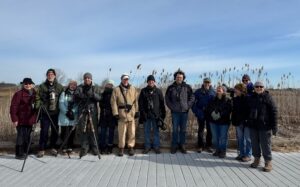
On Saturday, September 20th, fifteen bird watchers gathered at Ferry Park in Rocky Hill for the start of a bird walk into the Rocky Hill Meadows. This walk is focused primarily on the comings and goings of southbound shorebirds, especially Buff-breasted Sandpiper, Baird’s Sandpiper and American Golden-Plover, species which prefer and share similar drier habitats.
The trip got off on the right foot with fantastic looks at an adult Red-shouldered Hawk perched high, on the top snag of a dying tree. Also noted at the time was a Purple Finch calling overhead.
To reach the meadows, one has to pass through a small dense woodland, and then over a stream. From here, the road skirts a row of mature trees that border extensive farmland. It was at this juncture where we located a number of actively feeding migrant birds. Black-and-white Warbler, American Redstart, Northern Parula, Eastern Wood-Pewee and Scarlet Tanager were all observed.
Birders also noticed a lot of bird movement around the fruiting vines of Virginia Creeper. Eastern Bluebirds, American Robins and Gray Catbirds fed feverishly on their berries, as did a few Red-eyed Vireos. Sharp eyes also detected the presence of an uncommonly seen Philadelphia Vireo!
The woodlands were also great for spotting woodpeckers. Our group recorded five species, Red-bellied, Downy, Hairy, Pileated, and Northern Flicker.
The dirt road leading out into the meadows is nicely bordered on both sides by weedy plants and short shrubs. Birds that were flushed up into the tops of these plants allowed close up views at both Savannah Sparrow and Palm Warblers.
Another bird that allowed us close up views was a Northern Harrier, which flew off the ground and circled us on a number of occasions. What a treat!
As the temperatures began to rise, so did the sightings of different kinds of hawks. Both Cooper’s and Sharp-shinned Hawks kept our attention as they relentlessly harassed American Crows in a distant tree line. Meanwhile, an Osprey circled overhead, and a Peregrine Falcon was spied in pursuit of a flock of blackbirds.
Our journey into the heart of meadows continued for another mile or so. As luck would have it, a flock of three American Golden-Plover were incredibly found resting, right near the edge of freshly cut sod, one of the target species of our trip. American Golden-Plover’s nest in northern Canada and winter in southern South America. For many on our walk, the plover was a life bird!
From this point, we retraced our steps and headed back toward Ferry Park. Along the way, we added American Kestrel, American Pipit, a flyover Greater Yellowlegs and Pectoral Sandpiper.
Our trip tallied a total of 52 bird species.
Respectively submitted,
Paul Cianfaglione, trip leader
Keney Park – West Side Trip
Birding Trip Report– Sept 14, 2025
Trip Leaders: Annette Pasek, Al Gatti
28 Species Observed
2 hours, 8 minutes | 1.06 miles
Twelve birders showed up at the Woodland Street entrance which is the western portion of Keney Park. In the past we have birded the eastern portion of the park; so, this was a new experience for all. We had beautiful Fall weather and varying habitats including woodland, grass land areas and the pond area.
The highlight of the trip was seeing the yellow-billed cuckoo within 10 minutes of the bird walk. He hung around among several trees for a good 10 minutes; so, we all got great views. Barry Marsh also captured some great pictures with his telephoto camera.
1 duck sp. (flying fast and far away)
4 mourning dove
1 yellow-billed cuckoo
2 ruby-throated hummingbird
1 red-tailed hawk
1 belted kingfisher
4 red-bellied woodpecker
3 downy woodpecker
2 hairy woodpecker
3 eastern phoebe
12 blue jay
3 black-capped chickadee
4 tufted titmouse
3 white-breasted nuthatch
1 northern house wren
2 Carolina wren
5 gray catbird
3 northern mockingbird
5 eastern bluebird
1 wood thrush
2 American robin
1 house finch
8 American goldfinch
2 chipping sparrow
4 song sparrow
1 common grackle
2 northern cardinal
1 warbler sp.
Hilltop Farm Trip Report
September 3, 2025
Once upon a time, there was an elementary school librarian who retired and found she missed the chattering of little children and the camaraderie of the teaching staff. She reached out to a local nonprofit to connect with people, nature, and to stay physically active. The location is just 1.5 miles from home and an easy commute. Thus began my volunteer tenure at Hilltop Farm in Suffield, CT. I help create and maintain several of our bird-friendly and pollinator gardens (HAS helped with grants) and oversee the Community Garden. I lead this bird walk every year to connect with others in the birding world and to share this property, which has been a vital part of Suffield’s history and now a significant part of my retirement.
Today I led a group of 12, including my husband Tom. All were Hartford Audubon members. Some had visited the property before, others had not. (The Creamery may have had something to do with that.) We were fortunate to have beautiful weather with blue skies, puffy clouds, and a temperature in the low seventies, accompanied by no humidity. I started our walk by admitting I needed everyone’s help to identify birds, as my visual acuity is a bit impaired by cataracts that will soon be removed. I also mentioned that bird calls are not my specialty, even before being diagnosed with hearing loss. But what an understanding group they were! The Hartford Audubon insists you do not have to be the best birder to lead a walk. Share your enthusiasm and knowledge, and the camaraderie of the group will fill in the blanks. This group did just that! We identified 27 species and maybe two yellow warblers in the goldenrod.
We began our walk heading east from the red barn. Gray Catbirds started us off, and goldfinches, hairy and red-bellied woodpeckers, and eastern wood-pewees soon appeared along with cedar waxwings. To the north, on a dead tree, sat a Cooper’s Hawk and some northern flickers. At the bottom of the hill, we followed the wooded trail and slowly approached the inland pond, where one great blue heron and two green herons were across the water. Blue jays, crows, mourning doves, and Carolina wrens provided background chatter when things got quiet. We backtracked through the woods. Some ventured down to the riverbank and saw an osprey flying across the river. We returned to the open field where tobacco was harvested just last week, and the fields are brown and barren now. We walked parallel to the river, spotting robins and a cardinal along the way. We ventured up the hill with a ruby-throated hummingbird and turned right toward the boardwalk, where warbling vireos were high atop the canopy singing. Above the pussy willow arch on the boardwalk, more waxwings were spotted. The fields, now covered with goldenrod and joe pye weed, were summer breeding grounds for bobolinks, meadowlarks, and red-winged blackbirds. We only saw one blackbird today and two tree swallows in this area. We headed west and walked the road by the community garden, seeing goldfinches and song sparrows. One of our gardeners said it was a banner day for hummingbirds this morning, but I think they took an early lunch, as we did not see any while there. Up the hill again, a northern mockingbird was spotted on a post. We visited the Bird and Pollinator Garden (also HAS funded). A grackle, a starling, and a turkey vulture can be included in our observations.
You are familiar the saying, “The early bird catches the worm.” I may have to change it to, “The late bird catches the worm.” After everyone had left and we were packing the car, I spotted a flock of eastern bluebirds in the black cherry tree behind us. Sure enough, one of them was on the ground catching a worm!
Joan Heffernan

19 optimistic Hartford Audubon members met at Reservoir #3 in Bloomfield about 8am. I say optimistic because the weather forecast was threatening rain, but then early Saturday, the forecast moved the rain back to about 10am – so we hoped it would hold off. Reservoir #3 has about a ¾ mile long road out through a field which has had nesting Bobolinks the past several years. We were not disappointed. Everyone got really good looks at Bobolinks, both male and female, perched and flying. We also saw 33 other species of birds including a couple of nesting Great Blue Herons and surprisingly, and Orchard Oriole was heard. Some of us also had a good look near the end of the walk at a Willow Flycatcher which we’d been hearing. As promised, the first drops of rain started to fall at 10am! Here’s a list of the birds we saw.6 Mallard3 Mourning Dove1 Green Heron3 Blue Heron3 Red-tailed Hawk1 Red-bellied Woodpecker1 Eastern Wood-Pewee2 Willow Flycatcher1 Great Crested Flycatcher1 Eastern Kingbird3 Warbling Vireo1 Red-eyed Vireo1 Blue Jay8 Tree Swallow1 White-breasted Nuthatch8 European Starling6 Gray Catbird3 Eastern Bluebird3 Veery2 Wood Thrush6 American Robin5 Cedar Waxwing6 American Goldfinch6 Song Sparrow1 Field Sparrow1 Eastern Towhee1 Baltimore Oriole12 Red-winged Blackbird1 Brown-headed Cowbird2 Common Yellowthroat4 Yellow Warbler1 Northern Cardinal1 Indigo Bunting10 Bobolink1 Orchard Oriole35 Species total
On Sunday, June 1st, five bird watchers gathered at Station 43 in South Windsor for a three-hour walk featuring wetland bird species. The temperatures were unusually cool for this time of year (48 degrees), which certainly helped hold off the onslaught of mosquitos that were predicted to show up after two days of prior rain.
We began our trip near the parking area where a Red-tailed Hawk was discovered sitting in a well exposed nest. Above us, were the sights and sounds of over twenty Cedar Waxwing actively consuming the nectar from flowers on an old Tulip Tree.
After a brief greeting and introduction, the group headed off slowly down Newberry Road, birding and botanizing along the way. The loud vocalizations of Carolina Wrens, Common Yellowthroats and Yellow Warblers drowned out most of the surrounding birdsong, but we did luck out by hearing not one, but two Least Flycatchers along the trail. While observing the flycatchers, our attention was diverted to a Red-bellied Woodpecker, who was delivering a bill-full of insects to a nest hole!
The search for wetland bird species began with our arrival to the Station 43 Sanctuary itself. Here we spotted a few Wood Duck and a fly over Great Blue Heron. Marsh Wrens and Swamp Sparrows were heard singing in the distant reeds. Also heard were the distinctive calls of both Willow and Alder Flycatchers. The ubiquitous Red-winged Blackbird was seen throughout, with a striking all-black body and orange-red and yellow shoulder patch.
In the past, our search for the elusive Least Bittern could sometimes take a bit of patience and perseverance. But today our group was fortunate enough to quickly locate a bittern in flight, traveling from one side of the marsh to the other. It flew a second time a few moments later to the delight of all!
With our target bird secured, birdwatchers collectively decided to head over to nearby Vibert Road for some additional birding. Here we discovered that some of the farmland had recently flooded, which led to the appearance of a few late migrant shorebird species. We tallied five Greater and one Lesser Yellowlegs, as well as eight Semipalmated Sandpiper voraciously feeding on invertebrates as they refueled for their journey north. The standing water also produced a bumper crop of mosquitos, which also attracted numerous hungry Bank Swallows and Chimney Swifts.
Our trip tallied a total of 47 bird species.
Respectfully submitted, Paul Cianfaglione, trip leader
Eight people joined us for this spring walk around Fisher Meadows park in Avon Connecticut on May 17.
It was a cloudy foggy morning and the weather leading up to the day had generally not been great so our expectations for true migrants was low.
Therefore, we focused on the songs of many resident birds. We were not disappointed in finding many of the residence species, including Baltimore Orioles, Rose breasted Grosbeaks, Great Crested Flycatcher, Warbling Vireo, Orchard Orioles, and a good supply of Yellow Warblers. A double crested cormorant was seen fishing in the pond. We were lucky enough to find at least two Wilsons Warblers through their song and got decent looks at both of them. We also found a Magnolia Warbler via its song and then got some tantalizing views through the pine tree. There was at least one Canada Warbler heard briefly, but not everybody got on the bird or got looks.
We had a total of 40 species for the day.
Thanks to Barry Marsh keeping a list of what we saw and heard.
Brian Toal, Trip Leader