Category: Trip Report (Page 4 of 18)
Farmington River Park
Trip Report, Apr 19, 2025

Birding With Your Phone
Wednesday, March 5, 2025
Organizer Sarah Faulkner
Summary of Big January, 2025
From Sarah Faulkner
Our ninth annual Hartford County Big January of Birding challenge was a huge success once again. This yearly quest for individuals to see the most bird species in January in Hartford County brought out a large number of entrants this year. A brief warm spell at the start of the month turned into weeks of very cold, windy conditions that challenged many birders. Those able to see many species in January had to work hard for them!
As an organization, we witnessed a wonderful sharing of species sightings – from a Barrow’s goldeneye to a great cormorant, birders used eBird and the ctbirds listserve to help many others enjoy their sightings. Sharing also helped introduce birders to new locations. We all had a lot of fun!
Our 2025 winners are listed below. HAS awards certificates in these categories: Youth (ages 4-10): 25 species; Teen (ages 11-17): 35 species; Weekend Warrior Adults (ages 18+ whose day jobs ironically interfere with birding): 50 species, and Adult (ages 18+ who can get outdoors during the week): 60 species. It should be noted that finding even 50 species in Hartford County in January is no easy feat. All winners receive a certificate from HAS, and the adult with the most species will be celebrated at the HAS Annual meeting in May, along with the birder who found the most notable bird – our coveted “Golden Grebe” award. Special congratulations go to Sebastian Lawton, aged 15, with 49 species in the Teen category, and to Jamie Meyers for winning the adult category with 103 species. The Golden Grebe award winner will be kept secret until May!
Adults Category
Logan Barnes
Laura and Bob Bengtson
Debbie Bishop
Chris Chinni
Andrew Dasinger
Paul Danese
Sarah Faulkner
Jeff Fengler
Sue Gowen
John Graham
Jacob Gransinger
Jack Halibozek
Joan Heffernan
Thomas Heffernan
Connor Hogan
Tanya Janeczko
Jay Kaplan
William Kelly
David Lawton
Lisa Lukawicz
Sophia Marler
Barry Marsh
Jamie Meyers
Annette Pasek
Maryann Passalacqua
Maggie Peretto
Rebecca Rose
Julia Sheldon
Riley Sheldon
Russ Smiley
Davis Smith
Audrey Staropoli
Brian Toal
John Weeks
Zihan Wei
Debi Wheeler
Alison Wilcox
Chris Wilcox
Faith Ann Weidner
Joseph Wojtanowski
Teen Category (ages 11-17)
Sebastian Lawton (15 years old), 49 species
Trip Report – Cape Ann and Newburyport, MA
1/18/2025
Co-leaders: Fran D’Amico and Wendy Parsons
Attendees: Wendy and Roy Parsons, Fran D’Amico, Will and Gabrielle Bugden, and Annette and Bill Pasek
Stayed at Rockport Inn and Suites in Rockport, MA
Everyone arrived on Friday evening. The group met in the breakfast nook Saturday morning, had breakfast, and got ready to go out birding for the morning. We met outside by 8:30am. We made five stops around Rockport. They included Lanes Cove, Foley Cove, Halibut Point State Park, Cathedral Rocks (behind Emmerson Inn), and the Old Granite Pier. We returned to the hotel for lunch by noon. We left by 12:45 to go to Gloucester. We went to Bass Rocks, Eastern Point Light House, Niles Pond, and Jodrey State Fish Pier. We headed back to the hotel as it started raining at 4pm as promised. We went to Mile Marker One for dinner at 6pm. On Sunday, we headed for Newburyport, MA by 8:30am. We stopped at Mass Audubon Joppa Flats Visitors Center. We saw some American Wigeons and Eurasian Wigeons. We spent a small amount of time on Plum Island. We saw 53 different species over the weekend. We left Newburyport around noon due in impending snow storm.
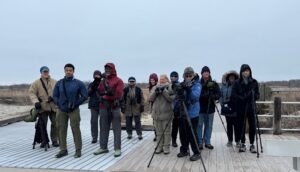
At 9:30 am, the weather at AW Stanley Park was clear, calm, and in the low 50°s F. Our group of 21 birders crossed the road between the parking lot where we met and the marsh, where we saw Dark-eyed Juncos and White-throated Sparrows foraging on the ground and in low branches of shrubs at the marsh edge, and in a red-leaved shrub farther into the marsh. A Swamp Sparrow was heard, and a male Northern Cardinal was spotted in a nearby tree. After reaching consensus on estimates for numbers of juncos and sparrows, we walked over to the WPA-era stone concession building next to the pond and counted House Sparrows landing and perching on the roof. Three Mute Swans were resting together on the lawn by the pond, Mallards swam and rested along the far edge of the pond, and one drake Mallard was feeding on aquatic vegetation at the water’s surface where the spillway from the marsh enters the pond. Blue Jays, an American Crow, and 6 gulls (likely either Ring-billed or Herring) flew over. Then 3 flocks of honking Canada Geese flew in and landed in the pond, each group bigger than the last, for a total of 59 geese.
We walked down the paved road to the Pines parking area; roadside trees, shrubs, and lawn held a Song Sparrow, Yellow-rumped Warblers, Black-capped Chickadees, White-breasted Nuthatch, Tufted Titmice, Golden-crowned Kinglet, Chipping Sparrows, Downy Woodpecker, Red-bellied Woodpecker, and more Dark-eyed Juncos. Then we spotted a vireo with an olive-green back, a pair of white wing bars on each wing, pale yellow on the sides of the belly, and no pale line through or over the eye. It was moving continuously as it foraged among the outer leaves of a medium-sized shrub by the roadside. White-eyed Vireo was our best guess, although I did not notice a yellow ring around the eye or a yellow line between the eye and the beak (as are found in that species); if present, they were relatively inconspicuous. Across from the Pines lot, from the bridge over the stream, we saw just one sparrow that flew across the stream too quickly to identify. We moved on to scan the crabapple trees in the small orchard area across from the playground, and the juniper (red cedar) trees south of the playground, seeing many crabapples, just a few berries on the juniper trees, and no birds. By then it was nearly 11 am, so we picked up the pace and proceeded to the forested area west of the pond.
Everything was going smoothly as we walked on the unpaved trails, until we came upon a large fallen tree across the trail ahead of us. Most of the group scrambled over the trunk and large branches in the trail, but I decided to lead a few of us into the woods to go around the tree, not anticipating the thorny multiflora rose canes growing beside the trail on the other side of the tree. Fortunately Ernie Harris had brought some small clippers and trimmed the canes in our way, but a few members of our group, not feeling like climbing over the fallen tree or walking around it, turned back the way we had come: my apologies for not having anticipated that obstacle! The rest of us continued down the trail, turned right onto the paved bicycle loop to cross the stream that flows into the north end of the pond, and then turned right again onto an unpaved trail through the woods and up a short hill to the basalt outcrop overlooking the pond. After admiring the view, we descended the other side of the hill and stopped at a floating dock “designed and constructed in 1999 by the CCSU Student Chapter of the American Society of Civil Engineers as part of the development of the nature trails” (A.W. Stanley Park Nature Trail Guide, 2nd edition, https://visitnbct.com/wp-content/uploads/2024/04/AW-Stanley-Trail-Guide.pdf ). From the dock we saw an American Coot swimming among the Canada Geese and Mallards, and a Red-tailed Hawk that landed near the top of a bare tree. We then proceeded across the bridge over the dam outflow from the pond, and had a good look at a Great Blue Heron standing on a partially submerged branch near the edge of the pond. Over the course of the morning, we also saw and/or heard American Robins, American Goldfinches, and Carolina Wrens, but the loose mixed-species foraging flock we found at the marsh and along the roadside at the start of the day accounted for most of the land birds we saw. Mixed-species foraging flocks will continue to move around within the park through the winter, a situation that leads to birding bonanzas alternating with birdless stretches. Then a flush of spring migrants will move through the woods (one year I heard about 12 Wood Thrushes singing from the woods behind the Pines parking area!), and then birds that breed in the park will become more uniformly but thinly dispersed as they settle onto territories they will defend for the breeding season.
By 11:50, we had covered about 1.6 miles and had seen or heard 27 species of our local feathered dinosaurs; the temperature had warmed to the low 70°s F.
Many thanks to Sharon Straka for recording our sightings and submitting them to eBird. If you’re looking for them there, the location is listed as AW Stanley Park, start time 9:26 am, observer “Anonymous eBirder”, currently available at https://ebird.org/region/US-CT-003/recent-checklists ; another member of our group separately posted his personal sightings starting at 9:28 am; that seems to happen fairly often on eBird, so they must be aware that there are redundancies between lists. Thanks also to HAS member Elaine Lechowicz for sharing historical information about the park with us, and for her role, with the Friends of A.W. Stanley Park, in saving the forested areas of the park from numerous development proposals over the past few decades, an encouraging lesson on the power of citizen groups speaking up at City Council meetings about why they value and want to protect local natural areas. Thanks to Ernie Harris for wielding his clippers and for keeping a separate species list we used to double-check our records at the end of the morning. And thanks to all the participants who spotted birds, helped others to find them, and helped with species identification: it was a pleasure to be with you!
Submitted by Sylvia Halkin – Trip Leader
Numbers of each species seen, in approximate taxonomic order:
3 – Mute Swan
59 – Canada Goose
29 – Mallard
1 – Red-tailed Hawk
1 – Great Blue Heron
1 – American Coot
6 – Gulls (probably Ring-billed or Herring)
3 – Red-bellied Woodpecker
1 – Downy Woodpecker
6 – Blue Jay
1 – American Crow
4 – Black-capped Chickadee
2 – Tufted Titmouse
1 – Golden-crowned Kinglet
3 – White-breasted Nuthatch
3 – Carolina Wren
4 – American Robin
1 – White-eyed Vireo (probably)
4 – Yellow-rumped Warbler
13 – House Sparrow
1 – Northern Cardinal
2 – American Goldfinch
15 – Dark-eyed Junco
3 – Chipping Sparrow
12 – White-throated Sparrow
2 – Swamp Sparrow
1 – Song Sparrow
Longo Farms Open Space Trip Report
October 11, 2024
Trip Leader: Annette Pasek
Longo Farms Open Space Walk, Glastonbury, October 11th, Five Attendees in total 3 Hours and 2 minutes
A chilly start to the morning, sunshine warmed the party as the morning went, with temperatures getting into the 50s. 37 Species, with the group missing some common such as Tufted titmouse. Though only one blurry siting of Eastern towhee graced the group when one bird took a deep dive for cover in meadow grasses, a surrounding group of four or more towhee vocalizing kept us on the lookout to try for another glimpse. The group had hawk species, multiple sparrow and thrushes. Five Phoebe kept the group counting.
Great Pond South Glastonbury Trip Report
September 14, 2024
Trip Leader: Annette Pasek
15 Attendees in all. Weather was pleasant with low lighting during our walk in the woods. 24 Species Observed with 2 unidentified, one a duck in flight and one a new world warbler sp. Northern parula and American redstarts graced our presence. Per usual after our round circle introductions, the parking area and entrance produced the most active area. A Barred owl called out early on in the walk. The most challenging view was Brown creeper. The group stayed on trail and avoided the fields. The path in the tall grasses had not been mowed.