Category: Trip Report (Page 7 of 18)
Cape Ann/Newburyport Trip Report
January 13 and 14, 2024
Trip Leader: Frances D’Amico
Participants: Al Gatti, Sharon Pope, Greta Gribkoff, Polly Parker, Roy Parsons, & Wendy Parsons
*Sharon joined the birders for meals and spent time exploring the area.
It was raining on Saturday morning and forecasted to last until noon. After breakfast, Al gave an impromptu tutorial in eBird which lasted till 10 am the rain had stopped. The six birders piled into 2 cars and headed out for the day’s adventure. It was a good day of birding in spite of the wind. There was one more short downpour in the late afternoon. Wind was the only remnant of the storm.
The first stop at Folly Cove where our bounty included Canada Goose, Mallard, Harlequin, and Long-tailed Ducks, Surf & White-Scoters, Bufflehead, Great Cormorant, American Crow, & Common Goldeneye.
Then on to Halibut Point State Park, where we walked out to the Point which juts out into the ocean. Birds had to be identified as they bobbed between the huge waves. Common Eider, Herring Gull, and a small flock of Northern Gannet flew by us. As the gannets got further out in the water, we observed how they dive head first into the water to feed. There were some songbirds (Tufted Titmouse and Carolina Wren as we emerged from the trail and back to our cars. After lunch back at the Rockport Inn, our last stops in Rockport were at the Granite Pier and Emerson Rocks which added Black Scoter, Common Loon and Common Merganser to our bird list before heading to Gloucester to finish the afternoon of birding.
Heading down the coast in Gloucester, we parked in the Elks lot and crossed the street. This has always been a reliable spot to see Purple Sandpiper, and they didn’t disappoint. It was impossible to get an exact count because the birds’ feather coloration blended well with the rocks and could only be seen when they moved. The waves were pretty ferocious, bringing the cold air off the ocean. Satisfied, we headed down to Jodrey Fishing Pier, where the boats bring in their catch to be processed. Lots of gulls were seen but none were white-winged. However, the bird of the day and maybe even the trip was a Dovekie – a small black and white bird in the Auk family which every one of our group was able to see.
Sunday we packed cars and had an early start to Newburyport environs. It was disappointing that the Mass Audubon building at Joppa Flats is no longer open on Sunday.
We crossed over the bridge to Plum Island and headed south onto the Parker River National Refuge stopping at Parking Lot 1, where we saw a pair of Northern Harriers. Next stop was the Salt Pannes, great for waterfowl this time of year and for shore birds in summer and fall. There was a Bald Eagle seen proudly sitting on a hillock taking advantage of this raised vantage point to survey the marsh. Our final stop was at Hellcat where we attempted to walk the boardwalk in search of land birds, but it was icy, and we retreated. Shortly thereafter our group began to retreat towards home. Maybe more of you will be tempted to join us next year and the lemmings will be gone forcing the snowy Owls to come further south in search of food.
Leader: Sylvia Halkin.
Participants were about 25 birders watching from paved and lawn areas around the Hartford Housing Authority building, 180 John D. Wardlaw Way, Hartford, CT, and thousands of crows.
The temperature was around 50 degrees F, winds were calm, and the clouds to our west were lit orange and yellow at sunset.
Between 4 and 4:30 pm, looking east from our hilltop location, we could see crows flying from north to south, sometimes in a dispersed line, sometimes in groups of a hundred or more: they appeared in the sky as tiny dots that got larger as they approached, and they flew on to disappear behind the trees to our south. At about 4:30, a Red-tailed Hawk landed in a tree at the edge of the parking lot and watched with us as about 800 crows flew in from the north, right over our heads, and landed near the tops of trees immediately south of us. We could hear the caws of American Crows, the more nasal double calls of Fish Crows, and rattling calls that are likely only given by female crows. Shortly after 4:45, the crows that had landed near us started to call more, rose circling from their trees, and then flew toward the trees on the west side of Newfield Ave. where we could already see clusters of crows in the upper branches. We could see many thousands of more distant crows flying from the southeast toward the same Newfield Ave. roost area: some may well have been the same crows we had initially seen flying by to our east, but the total number was much larger, in a denser group. Periodically groups of crows rose from the roost trees, circled, calling, and re-landed in the same area; this may be a display to attract stragglers to the roost, but twice seemed to be triggered by honks from a truck horn, perhaps from a non-fan of the crows roosting nearby. When we left at about 5 pm, the roost trees were quite full of crows, with more still flying into the roost area from the southeast, but far fewer new crows were arriving than 10 minutes earlier.
Thanks to Beverly Greenspan, who helped me to scout for the trip the evening before, Sarah Faulkner, who sent out an endorsing email, and everyone who showed up to enjoy the crow show!
September 16, 2023
Seven birders gathered for this hawk watch at Booth Hill in West Hartland, CT. Weather was cloudy, however we recorded 1 Osprey, 4 Bald Eagles, 4 Sharpshins, 2 Cooper’s; 100 Broad Winged and 2 Red Tail. Considering the weather, it was a good day for hawk watching.
September 17, 2023
A nice, sunny day with mild winds, perfect for viewing hawk migration. Six members gathered for this hawk watch. We were delighted to have our new president attend his first hawk watch event and witness his first Broad Winged kettle. We recorded 1 Osprey, 1 Bald Eagle, 1 Cooper’s, 1 Red Shoulder, 1 American Kestrel, 187 Broad Winged.
Thanks to all who participated and look forward to even more members joining us next September.
Submitted by Joan Lupacchino & Richard Nieman.
Submitted by Sylvia Halkin and Sally Rieger

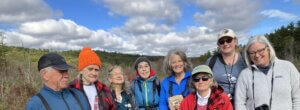
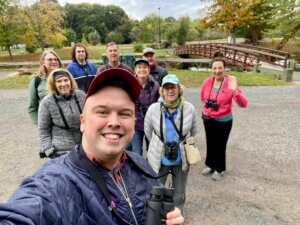
A couple of miles before we reached the forest, under an overcast sky with the air temperature in the upper 50s F, a small group of low-circling turkey vultures rose and was joined by a few more from below. Perhaps the ground surface had warmed just enough to generate rising air that they could ride without flapping their wings. We drove on to the Beaver Brook Road entrance to the forest, where Sally was waiting to guide us in, and parked along the road and in the little lot by the picnic area. At 9:30, our group of 9 gathered for a round of introductions, and then walked slowly over the bridge and down the road, listening for birds. We heard Tufted Titmice, Black-capped Chickadees, White-breasted Nuthatches, Red-bellied Woodpeckers, and Blue Jays in the trees, but caught only quick glimpses of a few individuals. Many of us were making Merlin sound recordings and were pleasantly surprised when the short trills we were hearing were identified as Winter Wren calls; they were reminiscent of Carolina Wren trills, but shorter and quieter. We did not see the wrens, or the Dark-eyed Junco that Merlin picked up, and we were not sure whether to accept Merlin’s ID of a Pine Siskin based on a very brief recording. It felt a bit odd to be walking down the gravel road looking at our smartphones to see whether Merlin was hearing anything we were missing, so it was a relief when a clearly audible Pileated Woodpecker called down the road ahead of us; although we didn’t see it, rectangular holes in the trunks of dead trees provided evidence of their work along the road and along the long boardwalk we later took through a marsh. A bird gliding with backswept wings, perhaps a Merlin or American Kestrel, was briefly spotted high in the sky above us. After about half a mile on the road, we walked down a short flight of steps to a long boardwalk that took us over a wet area dominated by pale green sphagnum moss growing under and between dark green shiny three-leaved goldthread, short mountain laurel shrubs, taller red-leaved blueberry bushes, and American/winterberry holly bushes with numerous red berries among green leaves. The boardwalk itself was decorated by fallen shiny red oval leaves of black gum/tupelo trees, and scallop-edged leaves of chestnut oak trees. There and at the next, shorter boardwalk we heard and occasionally saw Blue Jays, a Red-bellied Woodpecker, and Black-capped Chickadees; we heard multiple calls of a Red-shouldered Hawk from a location near calling Blue Jays, and decided that since the hawk and jay calls were not interspersed, the hawk calls were likely given by a hawk itself, rather than hawk-like calls given by a jay. The short boardwalk ended at a platform over a pond; we heard American Crows calling in the distance, and saw a couple of Blue Jay flights out over the pond and back to land. One member of our group saw and heard a Swamp Sparrow at the platform while she was waiting for us to arrive. A Hairy or Downy Woodpecker was also heard from a boardwalk. A Turkey Vulture was spotted in flight as the sky cleared to blue with clouds, and the temperature warmed into the 60s F. There was no sign of the numerous Red-breasted Nuthatches and White-throated Sparrows that were spotted and heard on the same walk exactly a year ago, and the leaves of shrubs and trees along the road were generally still green; sassafras and young tuliptree leaves had not yet turned the bright yellow we saw last year, though the Hobblebush leaves were again peach-colored; red leaves of the black gums and a few red maples were a visual treat that had probably fallen before last year’s walk. We want to thank the great walk participants, who patiently and skillfully located and identified birds on this challenging day for detecting them, and to thank Julia for volunteering to file an e-bird report for our trip. Following Max’s lead from Saturday’s trip, with permission of the photographed, we’ve attached a group photo too!
Bird species seen and/or heard, with approximate numbers of individuals, leaving out a couple of shaky IDs mentioned above:
1 Turkey Vulture
1 Red-shouldered Hawk
1 Pileated Woodpecker
6 Red-bellied Woodpecker
1 Downy or Hairy Woodpecker
11 Blue Jay
2 American Crow
11 Black-capped Chickadee
3 Tufted Titmouse
4 White-breasted Nuthatch
2 Winter Wren
1 Dark-eyed Junco
1 Swamp Sparrow
Date: Saturday, October 14, 2023
Location: Union Pond Park, 116 North School Street, Manchester, CT, 06040
Attendees: 8, plus trip leader

Weather: Overcast, raw, ~54°F
Species seen:
American crow
American robin
Belted kingfisher
Black-capped chickadee
Blue jay
Brown creeper
Canada geese
Carolina wren
Cedar waxwing
Common grackle
Downy woodpecker
Eastern phoebe
European starling
Gray catbird
Great blue heron
Common merganser
Mallard
Mourning dove
Northern flicker
Northern mockingbird
Red-bellied woodpecker
Red-shouldered hawk
Ruby-crowned kinglet
Savannah sparrow
Song sparrow
White-breasted nuthatch
Yellow-bellied sapsucker
Overview: We birded along the eastern side of Union Pond for approximately an hour and 45 minutes. (Serendipitously, today was Merlin’s October Big Day!). At first, we weren’t seeing nor hearing much, but soon enough we heard a few mixed choruses and spotted some fabulous species. Highlights included some rather moody kingfishers, an elusive brown creeper, a decade of common mergansers, and a great blue heron. The visit ended with some birding in the parking lot, where we identified a Savannah sparrow, a yellow-bellied sapsucker, and an Eastern phoebe. All in all, a great way to start the weekend.
eBird list: https://ebird.org/checklist/S152182921
Starting down the trail, we made a brief stop at the new bird and pollinator garden that has been planted thanks to a HAS grant. Our Pollinator Pathway friends spoke about the variety of native plants including expansion and maintenance plans for the future, and the ongoing work to reduce the invasive plants growing nearby.
From there we trekked through marshy, wooded/ brushy, and field habitats, tallying 28 species, and covering about 2.5 miles in just over 2 hours.
Highlights included Black and White Warbler, Palm Warbler, 2 Red Shouldered Hawks, many Eastern Phoebes and Eastern Bluebirds, and a nearly- constant presence of Blue Jays, Carolina Wrens, and Gray Catbirds.
Trip Leader Annette Pasek
Attending: 0
Total species: 17
The rain held off during my 1-hour jaunt into Great Pond Preserve. Temperate weather at 70 degrees, little to no winds. The very downcast cloudy skies made it difficult to see warbler groups clearly. This was a solo walk; the promise of rain may have kept others at bay. Many chickadees and titmouse accompanied me on my way down the main entry path. Most of my time was spent at the pond on the south side short trail and entrance near the great cedar tree. Surprisingly there was not a mosquito to be seen. Highlights included 12 Wood Duck lazing on the opposite side of the water. A steadfast Eastern Phoebe kept me company by wagging its tail while I stood by the water’s edge. Across the way a perched Belted Kingfisher called out it’s rat-a-tat-tat ricochet a few times. As I was departing the pond, a group of warblers moved in overhead, blackpoll and redstart to name a few, this group included a noisy set of titmice. On my way out I was treated to the calls of a Veery. It was a nice morning all in all, though I did miss the Red-shouldered that was picked up by Merlin’s sound app; but pleasantly met up with an Osprey on my way in and out.
Written and submitted by Trip Leader: Joan Heffernan
Why do people gather at 8:30 AM, on a late, hot summer day with the temperature at 68° and predicted to reach 93° but feel like 99° before the day’s end? Add in the humidity and bothersome mosquitoes to boot, one may wonder! Well, it’s because birding is fun! Enjoying nature, seeing familiar species, perhaps new ones, (and maybe a migrating warbler) defines our purpose. My motivation includes meeting birders and sharing a bit of history about this farm originally owned by George Hendee (Indian Motorcycle fame). Many bird sightings have been documented on this property which is maintained by volunteers. Today we welcomed two birders, members of the Hartford Audubon Society, who were first time visitors to Hilltop Farm and they left with the intention of coming back, preferably in cooler conditions! It was hot this morning!!!
Along with spotting 16 species, (a few LBJs escaped us) we conversed on the trail, talked about favorite birding encounters and saw where wetland plants, purchased with HAS grant money, were planted along the boardwalk to replace invasive species. After a short jaunt into the woods we approached an inland pond where two very cooperative green herons were perched on the opposite side. We walked uphill and passed through the community garden where hummingbirds and swallowtails were seen. It was a rather quiet morning for birds but the blue jays, goldfinches, woodpeckers, catbirds, mockingbirds and carolina wrens made their presence known. I did find myself pointing out “this is where we see Bob-o-Links, this is where we see wood ducks, northern harriers, swamp sparrows… The Bird Garden, host to several native plants granted from HAS, was our last bird viewing point. As we gazed at the giant mulberry tree near the garden, I heard myself saying, when this tree is fruiting, we see cedar waxwings, orioles …
I guess our new visitors will just have to return again in another season!