Author: Mona Cavallero (Page 9 of 17)
By Trip Leader Larry Lunden
A sunny day greeted us as we started out the walk. Three of us turned out to see what was in the park. Four if you also count Merlin.
The upper level of the quarry had the usual birds. Merlin heard an Ovenbird, and we heard it off in the distance. A Rose breasted Grosbeak was calling from a tree and we got a rear end look at it. Another tree held a Baltimore Oriole, and we got a good look at it. We had a flyover of a Fish Crow which we identified by call.
At the lower level we had Yellow Warblers calling near the tracks. Also a faint Wood Thrush in the distance.
The meadows were flooded due to the recent rains, so we omitted the caravan trip. We also studied the plants along the way. Many were blossoming with sweet aroma.
Overall we had 21 species, and two warblers.
Larry Lunden
Species at Quarry Park:
Canada Goose 8, Mourning Dove 7, Red-tailed Hawk 1, Red-bellied Woodpecker 4, Northern Flicker 2, Blue Jay 5, Fish Crow 1, Black-capped Chickadee 1, Tufted Titmouse 2, White-breasted Nuthatch 2, Carolina Wren 1, Gray Catbird 1, Wood Thrush 1, American Robin 14, American Goldfinch 1, Baltimore Oriole 1, Red-winged Blackbird 6, Ovenbird 1, Yellow Warbler 2, Northern Cardinal 3, Rose-breasted Grosbeak 1, Cardinal 3
By Abby Wolcott
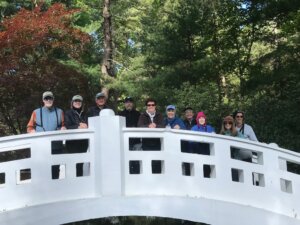
After several days of rain, the skies were clear and a handful of birders arrived at the trail head. We headed down into the sanctuary. We noted the lush greenery and before long a wood thrush beckoned us with his mournful, flute-like song. We homed in on his call and he was cooperative enough to appear with his fetching spotted pot belly. An assortment of the usual residents made themselves known including cardinals, red bellied woodpeckers, blue jays, chickadees, and tufted titmice. Our route took us over the Billy Goat Gruff Bridge, and we scanned the trees for warblers and a yellow warbler posted up on a branch in the sunlight making the past days of deluge seems like a distant memory. Further on, yellow-rumped warblers flitted in the treetops and a pair of phoebes kept ahead of us on the trail with their usual tail wagging and stellar posture.
We looped around admiring the wildflowers and gazed into the vernal pools which were quiet now that the peepers and wood frogs have found their mates. By the pools, the elusive oven bird called and called and we craned our necks to see this jaunty fellow. He had the last laugh by staying hidden, but we vowed to return again and seek him out.
Back over the bridge, we took a side trail to the south where trillium gave us quite a show with several color varieties. We admired the wildflowers and listened for spring migrants. As so often is the case, when we were scanning the treetops, stories were revealed about birding throughout New England and beyond and my own list of places to bird grew with each story.
We trekked up through the pine trees where, appropriately enough, a pine warbler serenaded us. We knew we couldn’t stay out all day so we headed back around the small pond at the beginning of the trail and headed up the hill. With each step we were reminded of how fortunate we were to spend a morning in this preserve of over 80 acres which has been set aside by forward thinking people and cared for by the HAS.
The morning of April 30th dawned cool, gray and drizzly. In spite of the gloomy conditions, nine hardy birders convened in the Roaring Brook Nature Center parking lot at 6:30 am to search the forest and fields for migrants and for resident species. After watching a “people=acclimated” hen turkey eating peanut bits on a picnic table, the group set out along the trail to the songs of a variety of species including house wren, Louisiana waterthrush and chipping sparrow. The black vulture that comes to the Center every morning to visit the captive vultures was sleeping in today, so our group headed directly to the field edges that are often good for migrants at this time of year. Along the way, we heard our first ovenbird of the season, and were treated to the song and a decent look at a brown creeper “creeping” up the trunk of an oak. The field edges provided looks at a variety of species including a male eastern bluebird feeding its mate, and a phoebe looking for insects as it hovered over the field, then returned to its perch flicking its tail. The songs of black-and-white and black-throated green warblers alerted us to a small warbler wave, but most of the birds proved to be the expected yellow-rumped warblers, one of our earlier warbler arrivals. Traveling across Bahre Corner Road, we encountered a more sizeable group of warblers, but alas, the birds were high in the trees, and the visibility was so poor that the majority of the birds were nothing more than silhouettes. We continued along the wooded trails, adding such species as blue-headed vireo, blue-gray gnatcatcher and pine warbler. It is evidently a good year for the Louisiana waterthrush on this property, as we encountered at least a half dozen of these birds loudly singing to stake out territories along Jim Brook and around Werner Pond. We also enjoyed numerous woodland wildflowers blooming along the trails. Returning to the Nature Center building, we went inside to shake off the cold and damp, and to add up our checklist for the walk. One member of our group lingered outside but for a minute to check off the American robin that had, to this point, eluded us. Total species for the trip was 31, and a full eBird checklist is available.
Jay Kaplan, Trip Leader
An 8 a.m. birding group started out with 13 attending and trickled down to 10 by the end of the 2+ hour walk. We entered Great Pond Preserve from its main entrance, which is located on the south side of Great Pond Road, Glastonbury. The walk covered approximately 1.3 miles. We had a slow start into the preserve. The group stayed put observing birds around the roadside entrance. This area can prove to be one of the birdiest spots, where in fact on our way out we did add our one Ruby-crowned Kinglet. Grey skies and chilly weather kept any warblers at bay and out of sight. It was difficult to observe the birds the first hour of our walk. Better lighting brought about improved looks. The Tree Swallows and Northern rough-winged Swallows as well as an Eastern Phoebe or two put a good show on at the pond near the preserve platform’s lookout.

Congratulations to all participants and thank you to those who joined us for dinner. It was great seeing you.
Annette Pasek, Merle Yoder and Lisa Lukawizc.
87 points

Maggie and Jack Peretto with our mascot Blaze. 64 points
60 points.
25 points.
Soon I will see you all looking for warblers.
- Ebird – from Cornell University, phone app as well as website org
- Merlin – from Cornell University, phone app as well as website https://merlin.allaboutbirds.org/
- Birdnet – separate database/software than Merlin’s, from Cornell University plus other research organizations. Phone app as well as website. Based on citizen science, more accurate than Merlin. https://birdnet.cornell.edu/
- Online bird guides such as Audubon, Sibley’s II, iBird, and the Warbler Guide
- Bird, Plant, and other Nature identifying apps:
- Seek – developed by team with iNaturalist – gives identification answer immediately
- iNaturalist- Uses a very large database and is a learning app – can be useful for identification but use with caution. Has a worldwide database, shares photos with other naturalists, engages with others in the field, once something has been confirmed by two others, stores information in a large database.
- AllTrails – helpful to find your way in the field
- eButterfly – can be used to identify butterflies
- Plantnet – for plant identification
Here is a link to the Birding With Your Phone video recording