Audibles and Edibles’ Trip report-4/27/19
Here is the plant list for Burnt Hill Park. And here the birds.
Audibles and Edibles’ Trip report-4/27/19
Here is the plant list for Burnt Hill Park. And here the birds.
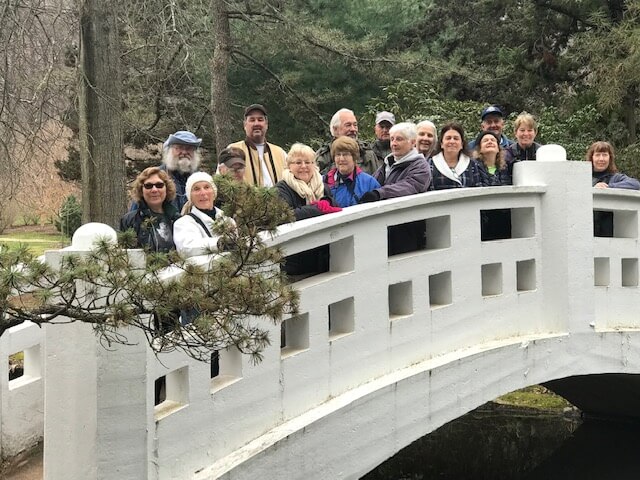
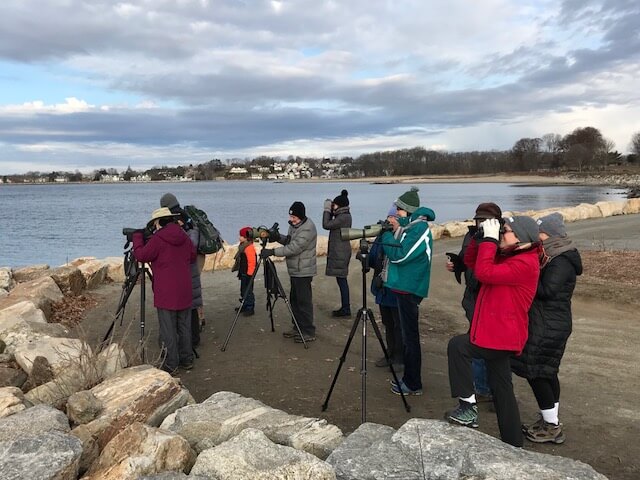
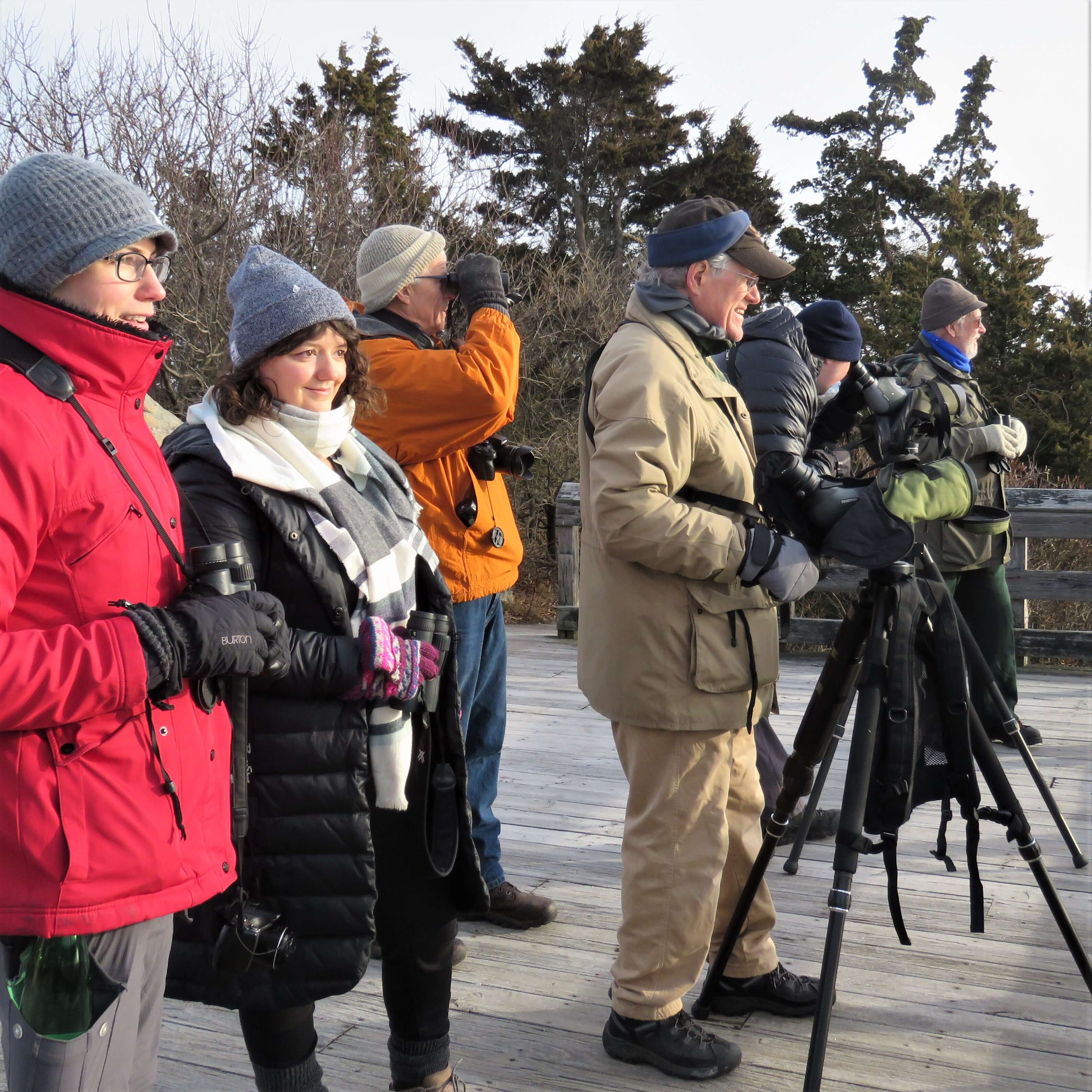
Eighteen birders joined the walk this morning. Was colder than expected and too early for all the beautiful flowers that will be blooming soon.
We had 26 species including three Ospreys circling overhead, Hermit Thrush and the song of a Winter Wren.
We have to try again but in May when we can enjoy the flowers, birds and hopefully a little sunshine.
Maggie Peretto
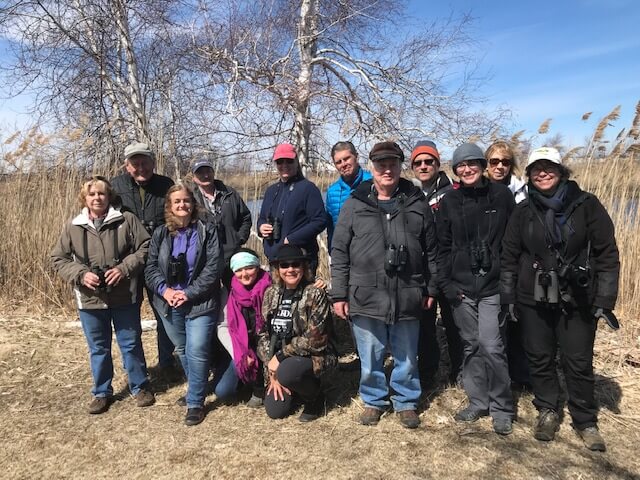
14 birders attended today’s Western CT Shoreline bird trip.
We saw a total 52 species including 20 killdeers, 2 Ospreys, 2 Fox Sparrows and an early Great Egret at Sherwood. It was cool and windy.
In Stratford at Bird’s Eye boat ramp we had various duck species including an Eurasian Green Winged Teal.
At the Long Beach Boulevard, at the Railroad track trail, we had 2 tree swallows and 1 greater yellow legs sandpiper.
At end of the afternoon a small group went to Long Beach to enjoy the waves, a large number of Dunlins and Sanderlings.
Respectfully submitted by Maggie Peretto

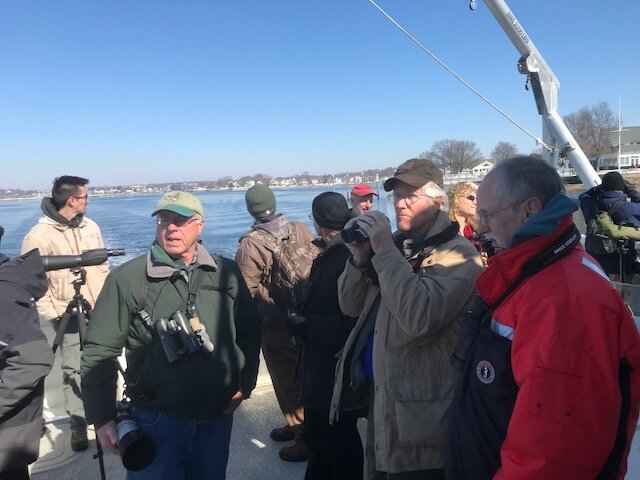
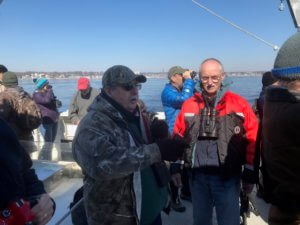
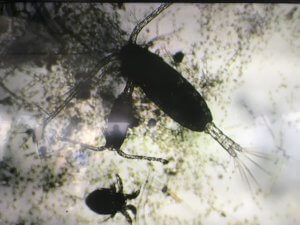
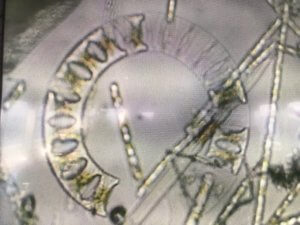
39 of us, plus 3 crew from the Maritime Aquarium, assembled at the Norwalk CT dock around 9:30 am and departed at 10 am for a six-hour cruise in LIS Long Island Sound. It was a gorgeous sunny morning with temperatures in the 40s. Our primary goal was to find the large flock of gulls which often assemble in these waters in March, apparently feeding on plankton of various types. We wanted to learn more about what these thousands of gulls were eating, more than a mile offshore, and of course, to look for any special gull species, such as Little Gull. We sailed SW around the Norwalk Islands and then went east toward Stratford. As we approached Bridgeport-Stratford waters, we could see a long line of white dots on the horizon, which turned out to be a flock of about 3,000 Ring-billed Gulls (also including 4 Iceland Gulls and 2 Bonaparte’s Gulls), in waters teeming with zillions of 1mm plankton and a few jellyfish. A plankton tow in these waters revealed barnacle larvae, copepods, and phytoplankton (diatoms mostly). We also took an underwater video which revealed small mobile worm-like creatures, with their identity TBD. Are the gulls and other species eating barnacles and/or these “worms”? The plankton samples we collected will be analyzed at several laboratories this month, with some to be preserved at Yale’s Peabody Museum. Everyone enjoyed the gulls, the plankton, the 39 people on board, the ship, the crew, and the amazingly beautiful warm sunny day on the water. Hopefully we can run this trip again next year, and will plan it soon. Details can be found at: https://sites.google.com/view/lisgullsplanktontrip/home
Respectfully submitted, Thomas Robben
“Western CT Shoreline”
Leaders: Maggie Peretto & Tina Green
Six years old Leon loved the great views of the Great Horned Owl. Tina Green set up her scope low so that he could see the owl. He was a great trooper walking under cold weather for a few hours. At Sherwood Island with the leadership of Tina Green, the group enjoyed close up views of a Gannet, several species of ducks, great looks at a pair of Great Horned Owls, Fox Sparrow, a pair of Eastern Towhees and much more. Later we visited a few points in Stratford where we had Great Egret, Snowy Egret, Pied-Billed Grebes, Black and Yellow Crowned night herons. To end the day with a bang we had a close up look at a Snowy Owl. It was definitely a successful day of birding.
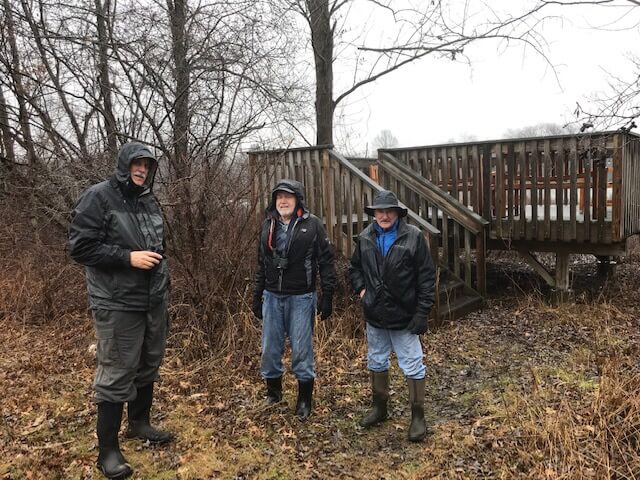
On a cold, rainy, foggy morning seven of us took a stroll through Station 43 to see what we could find, which ended up being a total of 26 species. While no rarities were seen, highlights included a Belted Kingfisher, a Winter Wren, a Carolina Wren, and several American Tree Sparrows.
As usual, at the end of the walk, we gathered at Dunkin Donuts to tally our sightings and bemoan all the birds not seen.
Respectfully submitted, Jon Ward
2018 HARTFORD CHRISTMAS BIRD COUNT SUMMARY
It wasn’t as bad as the forecast predicted. We didn’t really have any sleet or freezing rain, high winds never materialized and it did not rain heavily much of the day. That is not to say it was nice. Temperatures were relatively steady in the high 30s during the daylight hours and while it was damp throughout, there were long stretches during which it didn’t precipitate much if at all. Eighty-four field observers was a little below the norm, but they made up for it with time in the field. Total party hours were up slightly over 2017, and total party miles exceeded last year’s effort by over 100 miles! Quite remarkable on a miserable day.
Every Count is different and this year was no exception. In spite of November reports of pine siskins and even evening grosbeaks in the area, not a single winter finch was reported on the Hartford count for the second consecutive year. Temperatures well below freezing prior to the Count did not translate into the conditions we found last year. There was no ice on rivers, and in most locations, even still water was partially open. As such, several interesting species of waterfowl were recorded this year. Snow often concentrates birds into smaller, more predictable areas where food is readily available.
Speaking of food, several parties noted it was a poor year for nuts, seeds and fruit.
All the above factors contributed to numerous ten year low counts for a wide variety of species.
Although one of the primary objectives of the Christmas Bird Count is to track long term trends in bird populations, year to year fluctuations can swing wildly. For example, one year after reaching a ten-year high count, Canada Goose dropped to a ten-year low. Other species exhibiting ten year low counts included Mute Swan, Black Duck, Great Black-backed Gull, Yellow-bellied Sapsucker, Downy Woodpecker, Tufted Titmouse, Golden-crowned Kinglet, American Robin, Cedar Waxwing, Dark-eyed Junco, Brown-headed Cowbird and House Finch. In addition to the aforementioned winter finches, also missed on our Count this year were Marsh Wren (last missed in 2011) and Fox Sparrow (2014).
Not all the news was bad and there were a number of nice surprises this year. The only unusual goose reported was lone Greater White-fronted Goose found in the Rocky Hill Meadows. Perhaps this goose is becoming more common in our area as this was the sixth report in the past ten years for this once rare species. Bufflehead and Common Loon were both last reported in 2014. Killdeer has appeared twice as a Count Week bird, but was last found in 2013. Perhaps the best bird of the Count, a Northern Shrike reported from Newington, was last found on our Count in 2011. A single American Kestrel in Glastonbury was a welcome find. A Chipping Sparrow, also in Glastonbury, marked the third consecutive year for this diminutive sparrow, but only the fourth time in the past ten years. A Lincoln’s Sparrow sighting marked the third time in the past ten years for this elusive species. We reached ten year high counts for Field and Swamp Sparrow. The bulk of sparrow reports came from the incredible sparrow habitat found in the Glastonbury meadows. To the chagrin of birders, much of it is on private property and is generally not accessible to the public except on special guided walks.
Each year, several species, missed on the day of our Count, are sighted during Count Week, three days prior to and three days following Count Day. Although Snowy Owl did not make the list three years in a row, this year’s Count Week birds included Green-winged Teal, last missed on Count Day in 2013, Iceland Gull and American Pipit. The latter, seen as a Count Week bird, was missed for only the second time over the past ten years, but it has been missed in two of the last four.
Finally, let’s talk about crows. This year, the state’s largest crow roost has moved about a mile to the east. It has also, apparently, increased in size and was estimated at 19,000 birds. The roost usually remains until mid-February. If anyone would like an interesting experience, visit the Mark Twain House on Farmington Avenue in Harford late some afternoon around 4 PM. If you stand right in front of the Visitors Information Building, where many of the crows stage before flying south to the actual roost on Hawthorn Street a half mile to the south. You won’t be disappointed!
Total species for the Count stands at 84, five less than last year, but not surprising considering the less than ideal weather conditions. On behalf of the compilers, thank you to all the captains, field observers and feeder watchers for your efforts this year. Let’s hope for better weather in 2019! This was the 119th edition of the Christmas Bird Count, the longest running of all citizen science-based research projects. We hope to see many of you next year.
A ten-year spreadsheet for Hartford Christmas Bird Count results will be available at upcoming monthly meetings of the Hartford Audubon Society. It is also available by sending an email request to jaybrd49@aol.com.
Best wishes for the Holiday Season and the New Year!
Jay Kaplan & Steve Davis, Co-Compilers
Hartford Christmas Bird Count
12/9/18
The Hartford Audubon bird walk at Hammonasset State Park in Madison, CT began in the teens, sunny with seven birders, all HAS members.
Beautiful looks to the Sound: many Ruddy Turnstones and Dunlin on the jetty; but mostly quiet inland.
Highlights:
Barred Owls on Willard Island; Northern Harrier at a distance; one Lapland Longspur in with many Horned Larks and one elusive American Bittern in the marsh near the pavilion.
A nice wrap up at the nearby Fish Tale restaurant was enjoyed by all.
Respectfully submitted,
Ernie Harris
This trip was originally scheduled for May 19, 2018 but forecasts of high winds, high seas and rain caused postponement until June 3rd. On that new June 3rd date we had no rain but the winds kicked up and the seas became rough, forcing us to abort the trip after just three hours. The Captain kindly provided rain-checks for future trips on his whale-watching boat this year for all of the 70 birders and whale watchers on board.
We left the dock at 7am, with 2-3 foot seas, and a remarkably beautiful clear breezy day, around 60°F. Within several hours, however, growing winds caused 6-8 foot seas and too much bouncing around for good bird watching, so we elected to abort the trip and return to dock. We did see three humpback whales in central Stellwagen Bank along with the following birds:
80 Herring Gulls, 20 Greater Black-backed gulls, 3 Double-crested Cormorants, 2 Common Loons, 3 Northern Gannets, and 2 Wilson’s Storm-petrels. We tried but were unable to find any shearwaters, jaegers or waterfowl. The weather was also too dynamic to allow our plankton tow or deploying our Secchi disk.
We saw fewer birds than hoped for, but enjoyed a beautiful windy sunny morning on the ocean. The full trip report is available at trips33.blogspot.com.
Respectfully submitted,
Tom Robben
Theme by Anders Noren — Up ↑